DNV Approval for Composite Manufacturing in Klipphausen
Connova Deutschland GmbH has been approved by DNV as a manufacturer of fibre-reinforced plastic components.
Fiber-reinforced composite components for mechanical engineering, automation and robotics: booms and swing arms, beams and crossbars, split pots, straps and plates — from feasibility analysis to series production.
Experience in mechanical engineering, automation, and robotics.
Increased performance with lower energy consumption and low maintenance costs
Personal support from the feasibility analysis to series production
CFRP components reduce energy consumption and increase the performance of end products due to their lower weight. This is particularly crucial when it comes to maximum precision and especially fast movements. Fatigue strength and corrosion resistance ensure longevity and low maintenance costs. Upon request, we can support you as early as the concept phase and offer your engineers and developers competent advice. Together with you and your team, we can also meet the highest requirements within short deadlines – individually, efficiently, and economically.
The benefits become apparent wherever mass has to be accelerated and decelerated. Every reduction in the mass of a moving component has a double effect: the drive requires less energy, and the machine settles more quickly after positioning. Together, these effects increase the achievable cycle rate without requiring changes to the drive or control system. For rotating components, the critical speed also increases because stiffness and mass are in a more favorable ratio.
A CFRP component is therefore not simply a replacement part made from a different material, but a different design altogether. The fibers are aligned along the load paths, stiffness is tailored to the required directions, and loads are introduced through embedded metal inserts. Replicating an existing steel component one-to-one means giving up most of the potential benefits.
The values shown are indicative values for the material groups. Project-specific properties depend on the fiber type, laminate structure and resin system and are verified during the design process.
The greater the mass and the number of cycles, the faster the component pays for itself. On a machine operating in three shifts, every second saved in cycle time adds up over years of operation.
Weight, deflection, natural frequency, thermal expansion, corrosion or X-ray transparency. As soon as one of these factors limits the design, composites become a serious option.
From around 50 units per year, series production becomes economically viable. Several variants produced in smaller quantities can also be combined if they use the same tooling concept.
In practice, the starting point is almost never the material itself, but a physical limitation reached by a metal structure. These six drivers cover the majority of our industrial projects.
Booms, swing arms and gripper supports that are accelerated and decelerated many times per minute. Less mass means lower drive energy, shorter settling times and higher throughput with the same drive system.
Beams, crossbars and gantry axes where deflection increases disproportionately with length. A fiber-reinforced composite beam maintains precision where aluminum already begins to yield.
Shafts, sleeves and rotor retaining bands. Centrifugal force increases with the square of the rotational speed. A filament-wound CFRP component securely retains the magnets or rotor and increases the maximum speed limit.
Measuring equipment, optical assemblies and test frames. The coefficient of thermal expansion of CFRP can be tailored to near zero. Measurement results remain stable throughout the day.
X-ray-transparent components, high-voltage insulation and applications without disruptive eddy currents. The choice of fiber can be used to control what is transmitted and what is shielded.
Components exposed to aggressive media or used in cleanroom environments. Fiber-reinforced composites do not corrode, are resistant to many chemicals and can replace stainless steel in many applications.
We regularly manufacture the following types of components. Each entry represents completed projects, not a theoretical statement of capability.
Can’t find your component on the list? Most inquiries come to us as drawings of existing metal components with the question of whether they can be made lighter. That is exactly what our feasibility analysis is for.
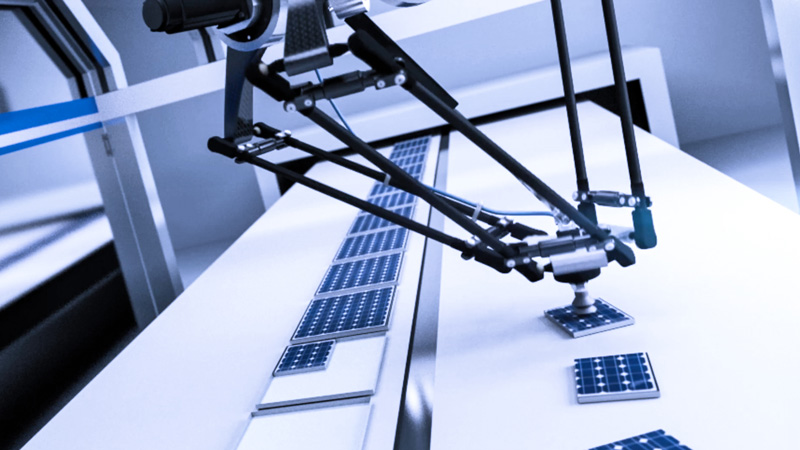
The Connova Group realized a statically and dynamically highly relevant mechanical engineering component made of aluminum and achieved clear improvements in the performance of a pick-and-place machine with a CFRP concept. A feasibility study, consulting with Besi’s designers, and the design of tools ultimately led to the successful construction of the CFRP rocker, including an adhesive bond with an accuracy of less than 0.015 mm.
Technical Core: Moving mass at very high cycle rates, bonding accuracy below 0.015 mm.
The Connova Group produced a boom made of carbon fibers and hard foam core for a «Pick and Place» robot in the packaging industry using the RTM process.
Technical Core: Sandwich construction using the RTM process, reproducibly manufactured in series production.
The Connova Group developed swivel arms made of prepreg high-modulus fiber for a robot palletizing system. These were manufactured in a 2-part negative and measured 1450mm.
Technical Core: High-modulus fiber for maximum stiffness with a 1,450 mm cantilever length.
The Connova Group’s services: development, calculation, laminate design, and manufacture of highly rigid end effectors for automated glass production. We have also integrated electronics and vacuum directly into the component.
Technical Core: Functional integration — vacuum channels and electronics integrated into the laminate instead of added as separate components.
The Connova Group develops and builds aramid fiber-reinforced components for the high-voltage sector for ABB. These series components are highly accurate and meet the tightest tolerance and surface requirements.
Technical Core: Aramid instead of carbon fiber — electrically insulating, with tight tolerances in series production.
The Connova Group developed a thermostable, high-precision housing for a distance measuring device. This was manufactured, assembled, and treated using prepreg technology.
Technical Core: Thermal dimensional stability as a prerequisite for reproducible measurement results.
Using adhesive technology, the Connova Group developed robot arms for the automation industry from CFRP tubes and coated aluminum milled parts.
Technical Core: Hybrid design — the CFRP tube carries the load, while the metal joint transfers the forces.
The Connova Group realized a load frame made of CFRP. Requirements: minimal thermal expansion, low weight, and high rigidity. Maximum pressure and tensile force were 2500 N.
Technical Core: Minimal thermal expansion under a 2,500 N test load.
For research purposes, the Connova Group developed a conical, gas-tight, and X-ray transparent tube with a low leak rate.
Further Details on the Product:
Technical Core: Gas tightness and X-ray transparency in a single component.
In industrial applications, fiber-reinforced composites are not an industry-specific solution, but a response to a specific physical requirement. This requirement occurs across a wide range of industries.
Booms, format parts and transport elements in machines operating at several hundred cycles per minute. Every gram on the moving axis directly affects throughput and energy consumption.
Placement heads, rockers and support plates that must withstand extreme accelerations while maintaining micrometer-range tolerances. Damping and dimensional stability are crucial to production yield.
Swing arms, end effectors and gripper supports. Mass has the greatest impact on dynamics at the end of the axis — this is where fiber-reinforced composites offer the greatest advantage.
Containment shells without eddy-current losses, as well as retaining bands and sleeves for high rotational speeds. We manufacture both as series products using RTM or prepreg processes.
Beams, rollers and moving tool carriers in machines with high web speeds. Low deflection across the full working width is the key criterion.
Load frames, instrument housings and optical supports. A coefficient of thermal expansion close to zero maintains measurement accuracy despite changing ambient temperatures.
Media-resistant components, internal fittings and vessel parts. Where stainless steel reaches its limits due to corrosion or weight, fiber-reinforced composites are often the more economical solution over the service life.
Panels, support elements and custom components for low-volume vehicle production. We clarify fire protection requirements according to EN 45545 with you in advance on a project-specific basis.
Pipetting and handling axes with high cycle rates. Lightweight axes enable higher throughput without compromising positioning accuracy.
From the initial idea to a series-ready component: we advise you, design and calculate machine components made from fiber-reinforced composites, and optimize existing automation systems precisely for your application.
We manufacture high-performance CFRP components using the process best suited to each application, whether prepreg autoclave, RTM or filament winding. Strict quality controls and on-time delivery ensure that the components integrate reliably into your production.
Our CNC services include model making, toolmaking and final machining of fiber-reinforced composite components for industry. Where required by the application, we machine to tolerances ranging from hundredths to thousandths of a millimeter.
We handle the mechanical machining of your fiber-reinforced composite components and support you throughout the entire production process — from individual machining steps to expertise and practical assistance for your in-house production.
Carbon fibers are hard and highly abrasive. They wear conventional cutting edges very quickly, while the resin matrix softens if the temperature becomes too high. We therefore use diamond-coated and diamond-tipped tools, adapted cutting speeds and an extraction system that captures fiber dust directly at the cutting edge.
Workholding is equally important. A thin-walled composite component deforms under clamping force if it is not supported across its surface. We therefore build the fixture in-house and design it together with the component, rather than afterward.
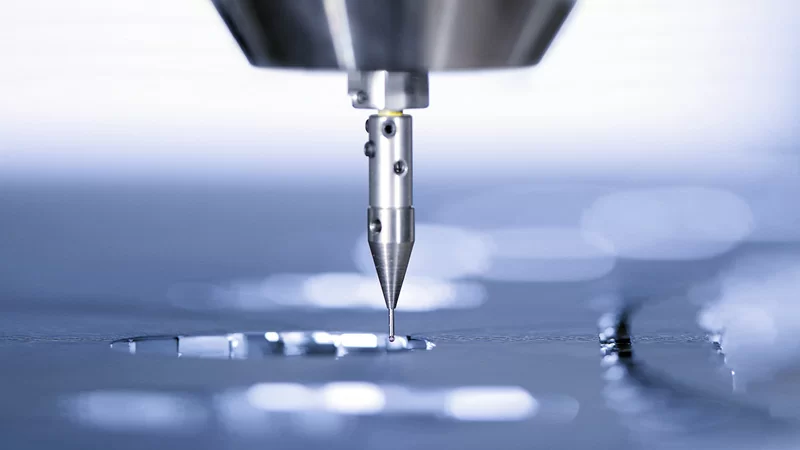
Precision must be measurable. We inspect critical dimensions directly on the machine using a touch probe, without unclamping the component. This preserves the reference, allows deviations to be corrected immediately and reliably maintains tolerances in the hundredth- and thousandth-of-a-millimeter range. On request, we document the measurement results in an inspection report.
Trimming, drilling, pockets and fits on components from our own production. We also machine finished assemblies and components, where required with tolerances down to the micrometer range. Machining and inspection are performed in the same fixture so that the reference remains unchanged from the first cut through to measurement.
We also machine composite components that were not manufactured by us, as well as models, tools and fixtures made of metal and plastic.
Master models, molds and clamping fixtures are produced in-house. This significantly shortens the feedback loops between the first component and final approval.
We often combine different processes within a single assembly — for example, a filament-wound tube with bonded metal joints, as used in the robot arms for Bosch Packaging.
Higher System Efficiency with CFRP Containment Shells Without Eddy-Current Losses
Bonding Accuracy of the CFRP Rocker Arm for the Besi Group
Cantilever Length of the Carbon Fiber Swing Arms Made from High-Modulus Prepreg
Production in Villmergen (CH) and Klipphausen (DE)
The Most Common Question from Engineers Is: At What Point Does It Become Economically Viable?
Below this volume, tooling and setup costs dominate the unit price. From around 50 components per year, these costs are distributed sufficiently for series production to become economically viable — with no fixed upper volume limit.
Important: They do not have to be 50 identical parts. Ten variants with five units each also count together, provided they use the same tooling and process concept. This is a typical scenario in special-purpose machine engineering.
At continuous operating temperatures above around 200 °C, resin systems reach their limits. For components driven purely by cost and without specific technical requirements, conventional materials are almost always the better choice.
Whether it is a one-off component or a series-produced part, the process is the same; only the scope of qualification differs.
We assess the load case, available installation space, production volume and target date, and tell you whether a fiber-reinforced composite is the right solution — even if the answer is no.
Laminate structure, fiber orientation and load introduction are designed and verified by calculation. Your engineers are involved throughout the process.
The manufacturing process, mold partitioning and demolding concept are defined together with the production team.
Models, tools and fixtures are produced in-house. Adjustments after the first component can be implemented directly and incorporated into the process.
The first component is measured and tested. Any deviations are fed back into the tooling and process before series production begins.
Documented approval with measurement and material verification, and upon request according to your own inspection plan.
Process parameters are finalized and documented. From this point onward, the component can be reproduced consistently.
Repeat and replacement parts are produced using the same tooling. We also handle repairs and rework on existing components.
Head of Sales Projects, Connova Deutschland GmbH
Jens Kählert combines mechanical engineering and industrial composites experience in one person. A Diplom-Ingenieur in Mechanical Engineering (born 1970), he started his career at composites pioneer Huber+Suhner and has personally accompanied the rise of high-performance composites into industrial applications for the past 35 years. Today he is Head of Sales Projects at Connova Deutschland GmbH and the central point of contact for composite solutions in industrial automation. His advantage for industrial customers: with more than 20 years of operational practice, he knows the entire supplier landscape and can assess from documented experience which composite solution actually delivers economically in which industrial environment.
Why You’ll Benefit from His Expertise:
“Industrial customers do not buy materials – they buy function over lifetime. My job is to define the composite solution that delivers exactly that: economically, with process reliability and reproducibly.”
— Jens Kählert, Head of Sales Projects, Connova Deutschland GmbH
Our quality management system originates from the aerospace industry. Industrial customers benefit from these standards without requiring the certification themselves.
Every fiber and resin batch is assigned to a specific component. In the event of a complaint, the affected material and process can be traced.
Once series production has been approved, parameters are no longer changed without the change being documented and approved. This ensures consistent components over many years.
Measurement and material verification documents are provided for approval. Upon request, these can follow your inspection plan or document format.
Design and process changes follow a defined approval procedure. Your purchasing and quality assurance teams always know which revision is being delivered.
We are accustomed to audits from the aerospace industry and also make our processes transparent to industrial customers.
Geometry and component inspections are carried out in-house rather than by a third party. This shortens the feedback loop between manufacturing and approval.
With composite materials, accelerated masses are significantly reduced. In addition, there are further advantages such as higher stiffnesses or more favorable natural frequencies, better resilience, higher vibration damping, and improved thermal stability. Composites often also simplify technical complexity. The Connova Group offers you feasibility analyses, product developments, and the manufacture of series components. We are happy to support you in the evaluation of your project and accompany you in the successful implementation.
Increase your system efficiency by 25% – No eddy currents, optimized fitting accuracy, and scalable series production for maximum performance.
Carbon sleeves and bandages optimized for higher speeds – Increase performance and efficiency with our scalable manufacturing.
Maximize the structural integrity and efficiency of your applications with our CFRP plates.
Six statements about our position in industrial lightweight engineering — each supported by verifiable information on this page.
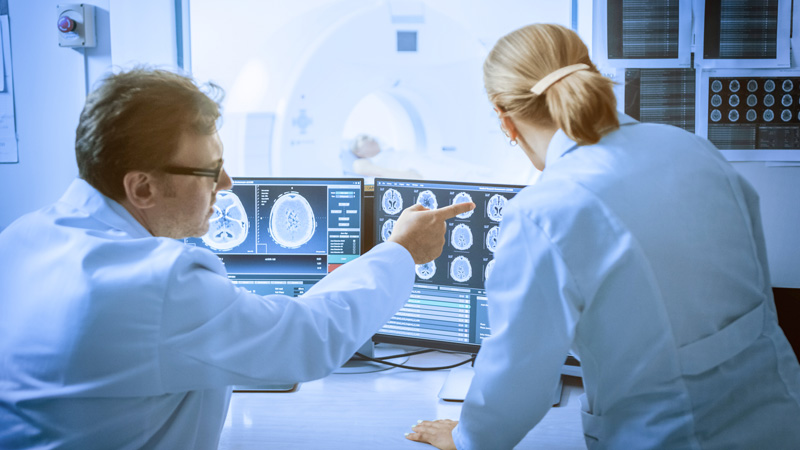
High strength, low weight, good corrosion resistance, and especially X-ray transparency make carbon composites particularly interesting for modern medicine. In our long history in the field of composites, we have acquired specific know-how in medical technology. This enables us to meet the highest requirements within short deadlines – individually and certified.
Specific Experience in Versatile Areas of Medical Technology
Strength, Lightness, Corrosion Resistance, and X-ray Transparency
Personal support from the feasibility analysis to series production
Thanks to the use of CFRP, it is possible not to change the patient positioning in spinal surgery during the operation process, including X-ray. The Connova Group provides the following services for Schärer Medical:
The patient table developed for the PSI is characterized by high positioning accuracy, which is achieved thanks to the stiffness and CNC machining precision. In addition, the table offers maximum X-ray transparency for proton beam therapy. Thanks to high-quality processing and lightweight CFRP sandwich construction, there are no disturbing artifacts, which leads to a significant improvement in therapy.
The Connova Group develops lightweight and X-ray transparent shell parts for REGA, which are characterized by high stiffness and strength. The corresponding stretcher is easy to clean. Further details:
Carbon composites not only expand the purely technical application possibilities; they also simplify handling in daily use. We accompany product engineers and other decision-makers from the first feasibility analysis to series production. We also support in the evaluation of the project and help to weigh prejudices and risks so that the overall product can be successfully implemented.
The questions engineers and purchasing teams most frequently ask us during an initial consultation.
Separation of individual laminate layers from one another. A common type of damage caused by improper machining or overload.
A metal element embedded in the laminate for load introduction, for example for bolted connections or bearing seats.
The proportion of fibers in the total component volume. The higher the fiber volume fraction, the greater the stiffness and strength at the same weight.
Curing prepregs in an oven rather than an autoclave, with consolidation achieved by vacuum only. With suitable resin systems, components with very low porosity can be produced.
A prepreg process in which the material cures in a heated mold under pressure. Short cycle times and two defined surfaces make it economical for series production of flat components.
With comprehensive know-how from decades of experience in lightweight construction for industry automation for well-known customers, we are perfectly positioned to implement your concepts. We invite you to a professional consultation, where we explore how we could act as your future partner. This initial consultation is of course non-binding and free of charge.
Connova Deutschland GmbH has been approved by DNV as a manufacturer of fibre-reinforced plastic components.
On July 23, 2026, the Themis T1H demonstrator successfully completed its first wet dress rehearsal
From March 10 to 12, 2026, the Paris Nord Villepinte exhibition center will once again