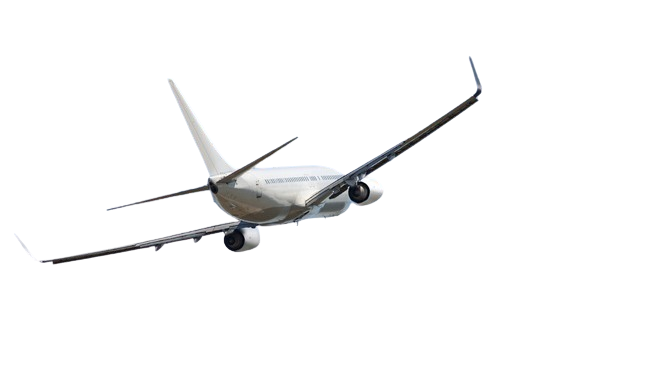
Composites for aviation

In the aviation industry, the proportion of composite components is traditionally high and can be up to 60%.

KNOW-HOW

Over 20 years of experience in aviation

INDIVIDUALITY

Customized solutions are our standard

COMPOSITES

Lightness and rigidity for greater efficiency in the aviation industry

High-performance components for the aerospace industry

The Connova Group has been active in the aviation industry for over 20 years. With our lightweight and stable composite components, we increase the efficiency and reduce the operating costs of ultra-light experimental aircraft, commercial airplanes, business jets, military jets, helicopters and drones.

We have a wealth of experience in the industry and offer customized solutions.

30–50 %

Weight reduction achieved by carbon fibre composites versus aluminium and titanium alloys.

Source · ScienceDirect 2025

20–25 %

Fuel savings achieved through composite-intensive aircraft design over conventional metal structures.

Source · Aerospace Industry Reports

~50 %

CFRP content by weight in modern wide-body aircraft like the Airbus A350 XWB and Boeing 787.

Source · Hexcel · Frontiers Mat. 2023 2023

1 kg

Every kilogram saved in airframe weight delivers measurable fuel savings and lifecycle CO₂ reduction.

Source · ScienceDirect 2024

High-Performance Composite Solutions for the Aviation Industry

For over two decades, the Connova Group has been producing high-performance, load-bearing components and structural parts for the aviation industry. Each element and component, from individual subassemblies to the complete construction of primary structures, is designed with optimal weight efficiency, stability, and durability throughout its lifecycle.

4

Aerodynamics in Perfection

From the robust airframe to the aerodynamically optimized wing, our composite materials are crucial for improving fuel efficiency and overall aircraft performance. By carefully integrating advanced materials into the fuselage, tail sections, as well as the nose and tail, we maximize aerodynamic properties and significantly reduce fuel consumption.

2

Precision in the Air

For the specific demands of helicopter construction, our specialized composite materials offer an unmatched combination of strength and light weight. The rotor blades we manufacture not only enhance performance and maneuverability but also set new standards for durability and reliability.

1

Accessibility and Protection

Our fairings and access systems are designed to provide maximum protection for critical components while facilitating maintenance access. Combining lightness, functionality, and aesthetic design, our doors and hatches ensure seamless integration into any aircraft design.

3

Propulsion and Control

Our engine cowls and nacelles are strategically developed to optimally protect engines and minimize drag. In the cockpit area, our advanced composite materials provide an ergonomic and safe environment. Our precisely manufactured drive shafts, end fittings, mounts, and brackets guarantee top functionality and longevity.

Taylan Toprak

Head of Sales & Project Management, Connova Group

Taylan Toprak holds a Diplom-Ingenieur degree in Aerospace Engineering from the Technical University of Munich (graduated 1993) and brings over 30 years of experience in aerospace engineering – including more than 17 years in senior composite-industry leadership. Prior to joining Connova Group in 2020, he served as Division Head of Aviation & Defence at MT Aerospace AG, where he led the acquisition and ramp-up of CFRP structures for programmes such as the Airbus A350 XWB and A400M.

Why you benefit from his expertise:

„In aviation there is zero room for compromise: every gram and every fibre must be right. Our commitment is to turn complex requirements into reliable, certifiable lightweight structures – from the first concept through to series maturity.”

— Taylan Toprak, Head of Sales & Project Management, Connova Group

Thomas Leschik

Managing Director, Connova Deutschland GmbH

Thomas Leschik combines a distinctive dual qualification: composite engineering from more than two decades of industrial practice and an aviation perspective as a trained sport pilot with a BZF-1 aeronautical radio certificate in English. This combination shapes his work for the aviation industry – he thinks through customer requirements not only from an engineer’s view, but from the cockpit perspective. As Managing Director of Connova Deutschland GmbH he is responsible for the development of CFRP-based structures for demanding aviation programmes, including Type 5 hydrogen pressure tanks for climate-friendly electric flight propulsion. A possible future field of application is flying research platforms such as TU Dresden’s Diamond DA62 MPP.

Why you benefit from his expertise:

“In aviation, every gram and every fibre has to be in the right place. As a pilot myself, I know this is not a slogan – it is an absolute requirement that defines every step of our engineering work.”

— Thomas Leschik, Managing Director, Connova Deutschland GmbH

Structural components, molds, tools & prototypes

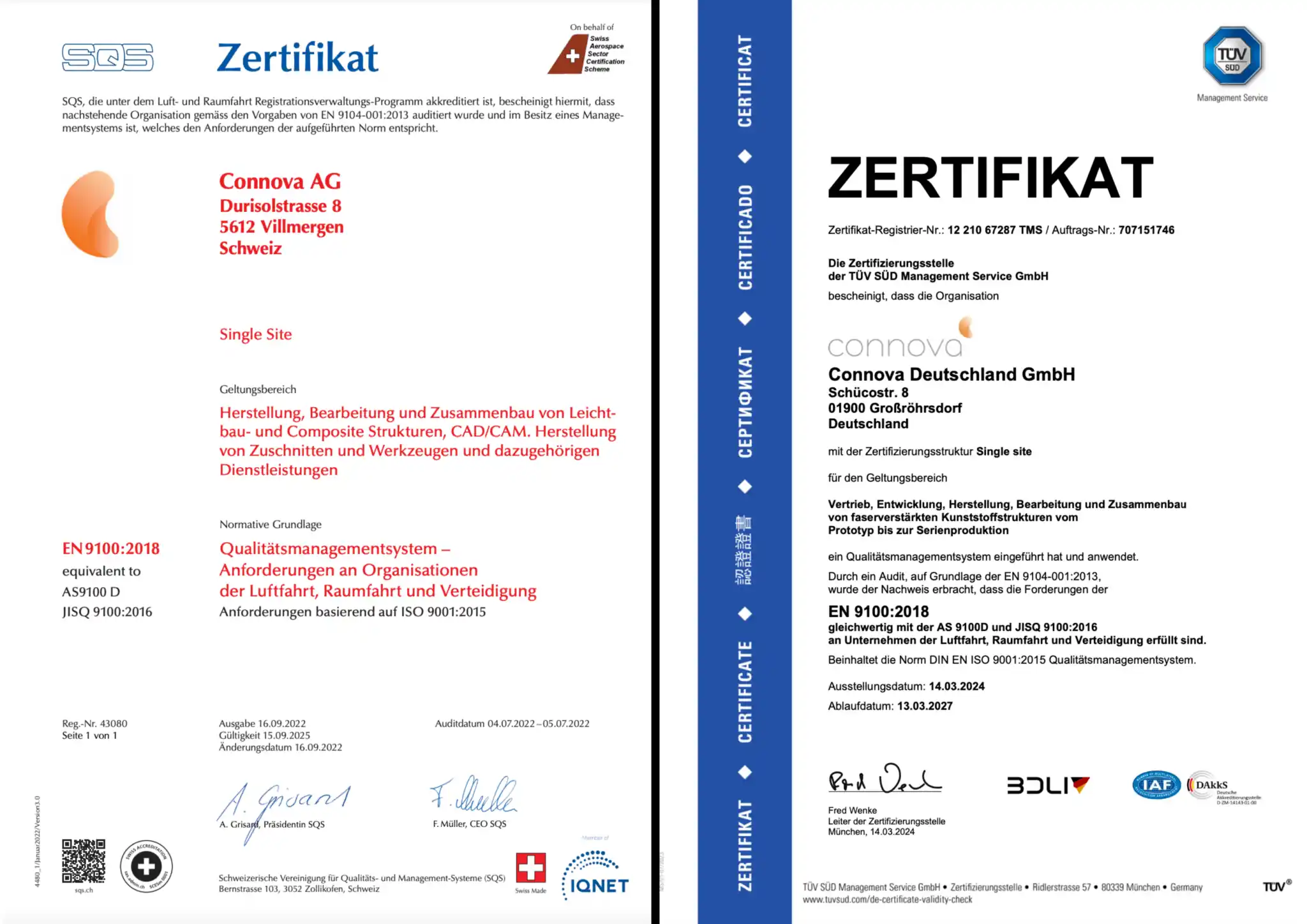
We offer structural components, molds, tools, prototypes and work closely with leading aerospace companies. All Connova Group production processes are 100% traceable and documented according to customer specifications. It goes without saying that our quality management system is aviation-certified in accordance with EN 9100.

Setting new standards in the aviation industry

We are setting new standards in the aviation industry through the advanced use of composite materials. Our advanced aircraft components offer an unmatched combination of lightness, strength and durability, optimizing aerodynamic properties and contributing to significant increases in fuel efficiency and performance.

Core competencies in the aviation industry

Icons 01 1

Tailored to Your Requirements

As experts in composite technologies in the aviation sector, we offer a wide range of services: This includes both consulting and the development of products for the aviation industry, as well as the design and analysis of aircraft components and the improvement of aviation systems.

Icons 03 1

Manufacture of Fiber Composite Components

With their extensive experience in the production of high-performance composite materials for the aerospace sector, our specialists ensure the most efficient production method for your aerospace product, always taking into account the strictest quality criteria and guaranteed reliability in delivery.

Icons 02 1

High precision for outstanding products

We offer a comprehensive portfolio of CNC services specifically geared towards model making, tool making and the final machining of composite components in the aerospace industry, always with a 100% accuracy guarantee.

Icons 04 1

From Production to Final Finishing

Our service portfolio covers all aspects of mechanical processing and support. This includes essential contributions to the production process of your aerospace composite components as well as additional support for your internal production.

Aerospace composite materials we process.

A complete overview of fibre and matrix systems qualified for aviation applications. Each combination engineered to specific certification, temperature and load requirements.

Reinforcement Fibres

Fibre System

Typical Application

Key Properties

Typical Aircraft Use

Carbon Fibre HT

Standard modulus carbon — secondary structures, fairings, cabin parts

Strength · Cost balance · Wide qualification base

Cowlings, panels, interior structures

Carbon Fibre IM

Intermediate modulus — primary structures, wing & fuselage

Higher stiffness · Aerospace-grade · Wide use in large airframes

A350 XWB, B787 primary structures

Carbon Fibre HM

High modulus — stiffness-critical applications, satellites, masts

Maximum stiffness · Premium cost · Specialised processing

Antenna booms, optical platforms

E-Glass

Cost-sensitive secondary structures, radomes, interiors

EM transparent · Good toughness · Cost-effective

Radomes, acoustic panels, fairings

S-Glass

Higher-performance glass fibre for impact-critical parts

Higher strength than E-glass · Improved fatigue

Leading edges, ballistic panels

Aramid

Impact-tolerant secondary structures, ballistic protection

Excellent impact & fatigue · Low compression strength

Cargo liners, fuselage skin protection

Matrix Resin Systems

Matrix System

Service Temperature

Key Properties

Typical Application

Epoxy RT–180°C

up to ~180 °C

Industry standard · Excellent mechanical performance

Most aircraft primary & secondary structures

BMI Bismaleimide

up to ~230 °C

Higher Tg than epoxy · Engine area applications

Engine nacelles, hot-zone components

Cyanate Ester CE

up to ~230 °C

Low moisture absorption · Dimensional stability

Antennas, satellites, precision structures

Phenolic

up to ~200 °C

Excellent fire-smoke-toxicity (FST) performance

Cabin interior parts, sidewalls

Sandwich & Core Materials

Core Material

Construction

Properties

Typical Application

Nomex® Honeycomb

Aramid paper honeycomb

Lightweight · Self-extinguishing · FST compliant

Floor panels, sidewalls, control surfaces

Aluminium Honeycomb

Metallic honeycomb core

High strength · Higher density · Excellent crush properties

Floor structures, engine nacelles

PMI / PVC Foam

Closed-cell rigid foam

Easy to machine · Lower cost · Wide temperature range

Sailplanes, secondary structures

Fibre-Metal Laminate FML

Aluminium + glass/aramid fibre layers

Excellent fatigue performance · Damage tolerance

A380 upper fuselage skin (GLARE)

Composite manufacturing processes for aviation.

Choosing the right process is as critical as choosing the right material. We operate the full process spectrum in-house — and select per project based on geometry, performance target, and series scale.

Manufacturing Processes

Best For

Surface Quality

Series Volume

Tooling Cost

Connova Capability

Prepreg Autoclave

Primary structures, high-performance parts

One-sided A · Other tool-finish

Low – Medium

Medium

RTM (Resin Transfer)

Complex integrated geometries

Two-sided A-finish

Medium – High

High

Hot Press

Repeatable secondary structures

Two-sided A-finish

High

Medium

Filament winding

Cylindrical & pressure-vessel parts

One-sided A · Mandrel-finish

Medium – High

Low – Medium

Vacuum Infusion

Large structures

One-sided A-finish

Low – Medium

Low

Wet Layup

Prototype, repair, experimental

One-sided

Low

Very Low

Trusted by the world's leading aircraft makers

03 01 02 Pilatus sRGB 800x450px 1

Components and Moulds

Connova Group is an established supplier to Pilatus for many years and provides following services for the customer:

  • Manufacturing of high-temperature resistant lamination and forming moulds
  • Design and manufacturing of fully automated vacuum fixation jigs
  • Manufacturing of structure and cabin components made of GFRP or CFRP by autoclave or hot press moulding
  • Highly precise milling and trimming of GFRP and CFRP components using modern CNC machining centres
03 01 03 Copter sRGB 800x450px

Structural components

For former Marenco Swisshelicopters, Connova Group has produced many different CFRP structural components. Among others, we have produced engine fixation elements, rear rotors and, at last but not at least, the complete passenger cell. For this ultra-stiff cell assembly, we have designed and manufactured roughly 80 different structural members.

03 01 04 Solarimpulse sRGB 800x450px

Wing and empennage structures

Connova Group has significantly contributed to this project from the very first concept phase all the way to the final assembly of the aircraft. For both aircrafts of SolarImpulse, we have manufactured and assembled ultra-light high-quality structural components – the baseline for the later world record!

EN 9100 certification meets top performance in the aerospace industry

We proudly maintain our demanding EN9100 certification in quality management for the aerospace industry and supplement this with the proven ISO 9001 standard. From the purchase of raw materials to the delivery of the finished product, we ensure continuously monitored and measurable quality.

Our state-of-the-art testing equipment ensures compliance with the strictest industry standards. Rely on us for precision and consistent quality at every stage of your product development.

Aircraft programmes & aerospace platforms we support.

Our composite parts and tooling have contributed to aircraft programmes across the full aviation spectrum. Specific component scopes are subject to confidentiality — the categories below illustrate breadth and platform diversity.

03 01 02 Pilatus sRGB 800x450px 1

Composite contributions to large commercial aircraft

  • Primary structure parts — CFRP · IM
  • Cabin interior components — Phenolic FST
  • Floor panels & sidewalls — Honeycomb
  • Tooling & jigs for OEMs — Tooling
03 01 04 Solarimpulse sRGB 800x450px

General aviation, business & light sport aircraft

  • Pilatus Aircraft components — CFRP · GFRP
  • Cabin trim & interior — FST grade
  • Cowlings & fairings — Secondary
  • Experimental aircraft structures — Prototypen
03 01 03 Copter sRGB 800x450px

Helicopter composite components

  • Kopter / Marenco SH09 cell — Full primary
  • Tail rotor structures — CFRP
  • Engine fixation elements — Structural
  • Helicopter cowlings — Secondary
03 06 01 Industry sRGB 800x450px

Ultra-light & world-record aircraft

  • SolarImpulse 1 & 2 wing & empennage — Ultra-light
  • Concept-to-assembly — Full lifecycle
  • Solar-powered platform structures — Custom
Bildschirmfoto 2023 01 25 um 18.23.19 removebg preview

Unmanned aerial vehicle composites

  • Fuselage & wing composites — Lightweight
  • Payload bay structures — Modular
  • Custom prototypes — Rapid
04_04_CFK_Spaltkoepfe_sRGB_800x450px

Composite tooling & production fixtures

  • High-temperature lamination moulds — Up to 200°C
  • Forming moulds — CNC-finished
  • Vacuum fixation jigs — Automated
  • Trimming & assembly fixtures — Series

Non-Binding Consultation for Aviation Composites

With comprehensive know-how from decades of experience in lightweight construction for the aviation industry, we are perfectly positioned to implement your concepts. We invite you to a professional consultation, where we explore how we could act as your future partner. This initial consultation is of course non-binding and free of charge.

Aviation composites terminology explained.

A reference glossary of the key terms used in aerospace composite engineering and manufacturing — useful for procurement, programme managers, and technical evaluators.

Carbon Fibre Reinforced Polymer

Composite material combining carbon fibres with a polymer matrix. Dominant material class in modern aviation primary structures, used in over 50 % of A350 XWB and B787 airframes.

Glass Fibre Reinforced Polymer

Composite material with glass fibres in polymer matrix. Used for radomes, acoustic panels, and cost-sensitive secondary structures. Electromagnetically transparent.

Pre-impregnated

Reinforcement fibre pre-impregnated with a partially cured resin matrix. Stored cold, processed under heat and pressure — typical for autoclave manufacturing of aerospace primary structures.

Resin Transfer Moulding

Closed-mould composite manufacturing process. Dry fibre preform placed in matched tooling, resin injected under pressure. Delivers two-sided A-finish at high fibre volume content.

Pressurised Curing Oven

Pressurised heated vessel used to cure prepreg laminates under elevated pressure (typically up to 7 bar) and temperature. Industry standard for aerospace primary structure manufacturing.

Bismaleimide

High-temperature thermoset matrix system. Service temperature up to ~230 °C, used for engine area and high-temperature aerospace applications where epoxy is insufficient.

Aerospace QMS

Aerospace quality management system standard, based on ISO 9001 with aviation-specific requirements. Mandatory for most aerospace supply chains and audited annually.

First Article Inspection

Documented verification that a manufactured part meets all engineering and quality requirements. Mandatory step before transitioning from prototyping to certified series production.

Non-Destructive Testing

Inspection methods (ultrasonic, X-ray, thermography) that evaluate part integrity without damaging it. Standard requirement for aerospace composite primary structures.

Honeycomb Sandwich

Construction with two thin composite face sheets bonded to a lightweight honeycomb core (Nomex® or aluminium). Maximum stiffness-to-weight ratio for floor panels and control surfaces.

Fibre Volume Fraction

Percentage of fibre by volume in a cured composite laminate. Aerospace prepregs typically reach 55–60 % FVF for optimal mechanical performance.

Fire-Smoke-Toxicity

Aviation cabin material requirement: low flame spread, low smoke emission, low toxic gas release in fire. Critical for cabin interior composites and certified through specific test standards.

Composites for every industry

Aviation

In aviation, the material proportion of composite components is traditionally high and amounts to up to 60%.

UAV / Drones

Unmanned aircraft and drones for a wide variety of applications are shaping the future of mobility.

Aerospace

Very light and ultra-stiff carbon fiber composite structures are the standard for demanding structures in aerospace.

Motorsport Automotive

Fiber composite structures have shaped racing from the beginning. We have been bringing the technology to the road for over 30 years.

Engineering

Composites follow different design rules than metals. We have these laws in our genes. You have the advantage.

Industry Automation

Composite components are becoming increasingly important in mechanical engineering, automation, and robotics.

Aktuelle Neuigkeiten