DNV Approval for Composite Manufacturing in Klipphausen
Connova Deutschland GmbH has been approved by DNV as a manufacturer of fibre-reinforced plastic components.
Unmanned aircraft and drones for a wide variety of applications are shaping the future of mobility.
Meeting the highest standards for production and processes for UAVs and drones.
Certified compliance with UAV & drone customer specifications.
Fast response and production times for UAVs and drones.
Drawing on years of experience in the aerospace engineering industry, Connova Group has also been active in the field of professional drones for several years. As with all aircraft, lightweight construction plays a crucial role in unmanned aerial vehicles as well.
Every kilogram saved in structural weight translates to more payload, more fuel, or both. Our expertise in the development and manufacture of lightweight structural components ensures the successful implementation of lightweight construction projects for highly efficient drones.
For unmanned aerial vehicles, the structural weight determines the key performance metrics: payload, range, and flight duration. Carbon-fiber-reinforced plastic (CFRP) offers a stiffness-to-strength-to-weight ratio that cannot be achieved with aluminum or titanium. This is precisely why fiber composites are the standard material for demanding UAV structures.
CFRP structures significantly reduce structural weight compared to metal while maintaining dimensional stability. This gives every UAV more capacity for sensors, power, or range.
Under cyclic loading, fiber-reinforced composites fatigue more slowly than many metals and do not corrode—an advantage for platforms with high operating frequencies and for maritime or outdoor applications.
Multiple functions can be integrated into a single component—load-bearing structure, aerodynamic surface, and mounting points—all within a single laminate. This reduces the number of parts, weight, and assembly effort.
Fiber-optic laminates are electromagnetically transparent and are suitable for antenna covers and radomes without interfering with the payload’s radio communication.
With the right matrix system, components maintain their dimensional stability across the entire operating temperature range—from high-altitude cold to the heat of an engine environment.
Composites follow different design rules than metals. Load paths, laminate structure, and fiber orientation are specifically tailored to the respective UAV structure.
From the entire system architecture to individual structural components and assemblies including rotor blades and compliant fuel tanks, we offer our customers the entire range of development and production for unmanned aircraft and drones. Our quality manual is air-certified according to EN 9100.
As experts in drone and UAV composite solutions, we offer a wide range of services: advice, development of UAV products, construction and calculation of drone parts as well as optimization of drone and UAV systems.
Thanks to our many years of experience in manufacturing high-performance composites for drones and UAVs, our experts guarantee the most efficient production method for your UAV product, while maintaining the highest quality standards and delivery reliability.
We offer a comprehensive range of CNC services specifically for model making, mold making, and the final machining of composite components for drones and UAVs, always with a 100% guarantee of precision.
We offer a broad range of machining and support services that can either be integrated into the production process of your drone and UAV composite components or provided as complementary support for your own manufacturing operations.
From fixed-wing aircraft to cargo drones: We develop and manufacture composite structures for the entire spectrum of unmanned platforms.
Surveying, mapping, and monitoring. Lightweight CFRP fuselages and wing spars extend range and flight duration.
Rigid, lightweight boom arms and frame structures for stable flight control and a higher payload.
Heavy-duty primary structures and airframes with aviation-specific requirements for reproducibility.
Load-bearing structures and conformal tanks for range and payload—just like in the Aero2 program.
Reconnaissance and surveillance platforms with requirements regarding weight, rigidity, and signature control.
Ultralight, highly rigid structures designed for long service life at high altitudes.
From individual parts to complete primary structures—the range of composite components we develop and manufacture for unmanned aerial vehicles.
Fiber, matrix, and core materials that we use for UAV applications. Each combination is designed to meet specific load, temperature, and quantity requirements.
The choice of process is just as critical as the choice of material. We handle the entire range of processes in-house and select the appropriate one based on geometry, load requirements, and production volume.
Head of Sales & Project Management, Connova Group
Taylan Toprak holds a Diplom-Ingenieur degree in Aerospace Engineering from the Technical University of Munich (graduated 1993), bringing over 30 years of aerospace experience. As Head of Sales & Project Management at Connova Group, he combines deep composite expertise with strategic market insight for emerging segments such as UAV and drone systems. His background spans more than 17 years in senior composite-industry roles – from certified high-volume production for manned aviation to agile low-volume runs for unmanned platforms.
Why You’ll Benefit from His Expertise:
„UAVs and drones place unique demands on weight, stiffness, and reproducibility. We bring manned-aviation quality standards into the unmanned world – delivering composites you can trust at series scale.“
— Taylan Toprak, Head of Sales & Project Management, Connova Group
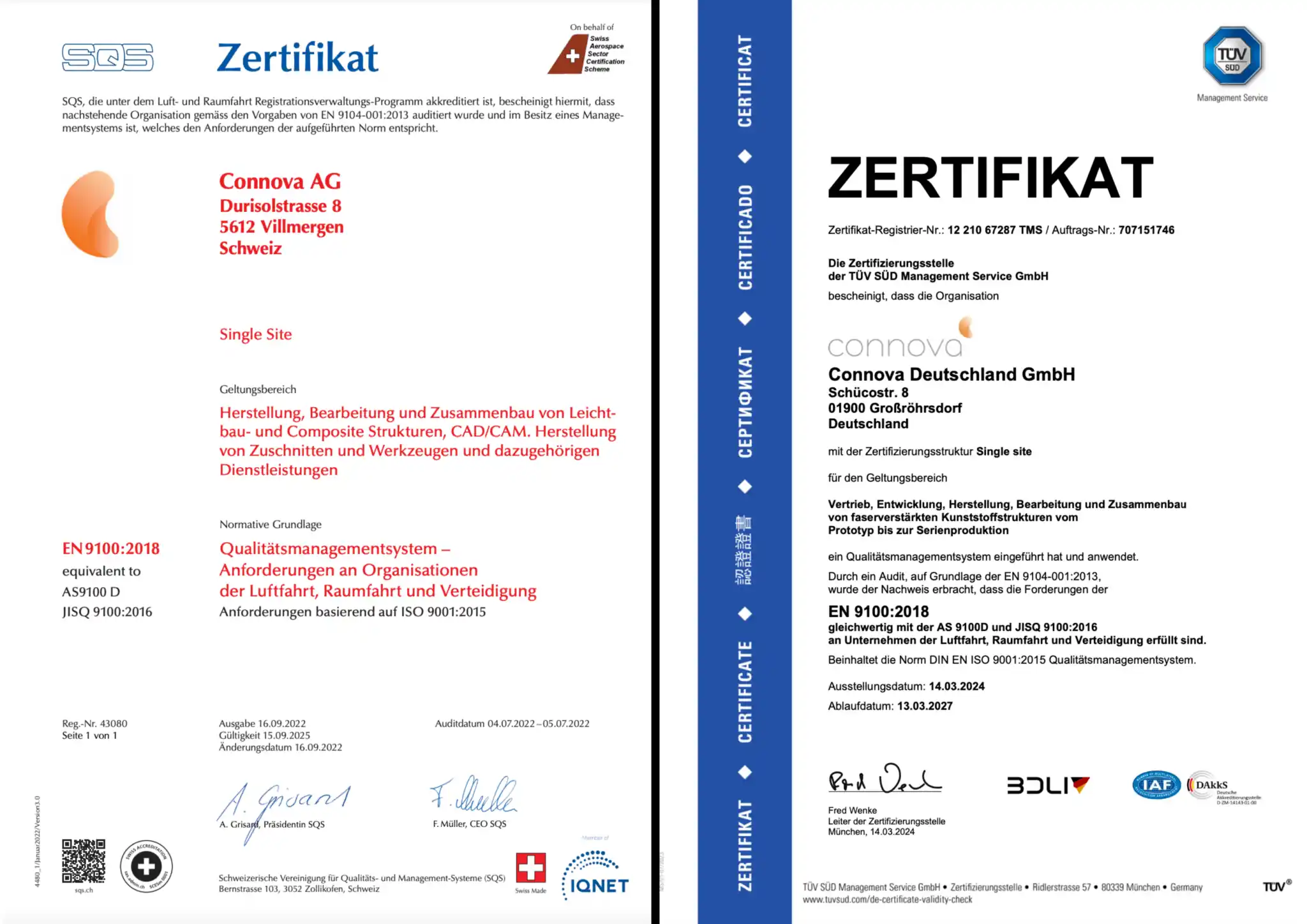
In addition to our standard ISO 9001 certification, we are proud to hold our higher-level EN 9100 quality management certification for the aerospace industry. We guarantee controlled, measurable quality from material procurement through to delivery of the final product. With our high-precision testing equipment, we meet the highest industry standards. You can count on us when it comes to precision and consistent quality assurance.
The Connova Group is the prime contractor for the manufacture of the primary structure of the Aero2 Cargo drone from Dufour Aerospace. The load-bearing structure includes the main assemblies “wings” and “fuselage,” as well as many other secondary components. The entire structure is manufactured using carbon-fiber-reinforced plastic (CFRP) construction—incorporating some highly innovative design principles that are being used for the first time worldwide in components of this kind. True to the motto: New Ways in Composites!
Integrating a fuel tank into an already tightly packed drone is typically a particular challenge. Not only is precise control of the center of gravity a key requirement, but so is the fundamental question of whether—and to what extent—the tank should bear structural loads. Weight optimization, leak-tightness, center-of-gravity control, and slosh protection are what turn a CFRP tank into a “flying” CFRP tank. We are proud to have already implemented various tank projects for aircraft—the external shape is no limitation for us.
Every propeller—whether for an aircraft engine or a helicopter—requires rotor blades tailored to its size and power. Precision and quality influence the aircraft’s performance characteristics and reliability. Commercial solutions are often unavailable for rotor blades that meet these requirements. Connova’s engineers therefore specified, developed, tested, and, in collaboration with the customer, qualified CFRP rotor blades for a drone weighing over 100 kg. The material and development data obtained represent a valuable asset for similar projects.
The Connova Group is pleased to confirm its selection as the primary supplier for Dufour Aerospace’s Aero2 composite airframe. The fuselage’s key components—the main wing, fuselage, and engine nacelle—are manufactured at the Connova AG production facility in Villmergen (Aargau), Switzerland.
Unmanned reconnaissance and surveillance platforms place special demands on lightweight construction, stiffness, and reproducibility. Connova manufactures lightweight, high-strength carbon-fiber-reinforced plastic (CFRP) structures for defense and ISR applications—from airframes to payload structures.
From fixed-wing aircraft to cargo drones: We develop and manufacture composite structures for the entire spectrum of unmanned platforms.
CFRP offers a stiffness-to-strength-to-weight ratio that surpasses that of aluminum and titanium. For UAVs, every kilogram of structural weight saved directly increases payload, range, or flight duration. Added to this are fatigue and corrosion resistance, as well as the ability to integrate multiple functions into a single component.
Fuselages and airframes, wings and spars, rotor blades and propellers, conformal fuel tanks, payload and gimbal structures, RF-transparent antennas and radomes, landing gear, as well as fairings and flaps—from individual components to the complete primary structure.
Yes. Connova transforms prototypes into reproducible small- and medium-volume production runs—the typical batch size in the UAV market. The processes (prepreg autoclave, RTM, hot pressing) are selected based on the quantity, geometry, and load requirements.
Prepreg autoclave, RTM, hot pressing, winding, vacuum infusion, and wet lamination—all handled in-house and combined as needed for each project.
Compared to aluminum and titanium alloys, a 30–50% reduction in structural weight can be achieved, depending on the component.
Yes. Our quality management system is certified to EN 9100 for the aerospace industry, supplemented by ISO 9001. This means that unmanned aircraft are subject to the same quality standards as manned aircraft.
Yes. Both have been implemented as reference projects—including critical component inspections and leak testing for the tank, as well as the design and qualification of rotor blades for UAVs weighing over 100 kg.
Yes. We supply lightweight, rigid structures for reconnaissance and surveillance platforms. Learn more on the “Composites for Defense” page.
From feasibility studies and design to process development and prototyping, all the way to quality-assured series production—with a single point of contact throughout the entire lifecycle.
Yes. Fiber-optic laminates are electromagnetically transparent and protect the payload’s radio link without interfering with it.
Decades of experience based on countless lightweight construction projects. Let’s talk on the phone to see if we’re the right partner for you. We’d be happy to offer you a free, no-obligation consultation.
Key Terms in the Development and Manufacturing of Composite Materials for Unmanned Aerial Vehicles—a reference guide for procurement, project management, and technical evaluation.
In the aviation industry, the proportion of composite materials in components is traditionally high and can be as much as 60 percent.
Unmanned aerial vehicles and drones for a wide variety of applications are shaping the future of mobility.
Very lightweight and highly rigid carbon fiber composite structures are the standard for demanding applications in the aerospace industry.
Fiber-reinforced composites have been a staple of motorsports since the very beginning. For over 30 years, we’ve been bringing this technology to the road.
Composites follow different design principles than metals. This expertise is in our DNA—and that’s to your advantage.
Composite components are becoming increasingly important in mechanical engineering, automation, and robotics.
Connova Deutschland GmbH has been approved by DNV as a manufacturer of fibre-reinforced plastic components.
On July 23, 2026, the Themis T1H demonstrator successfully completed its first wet dress rehearsal
From March 10 to 12, 2026, the Paris Nord Villepinte exhibition center will once again