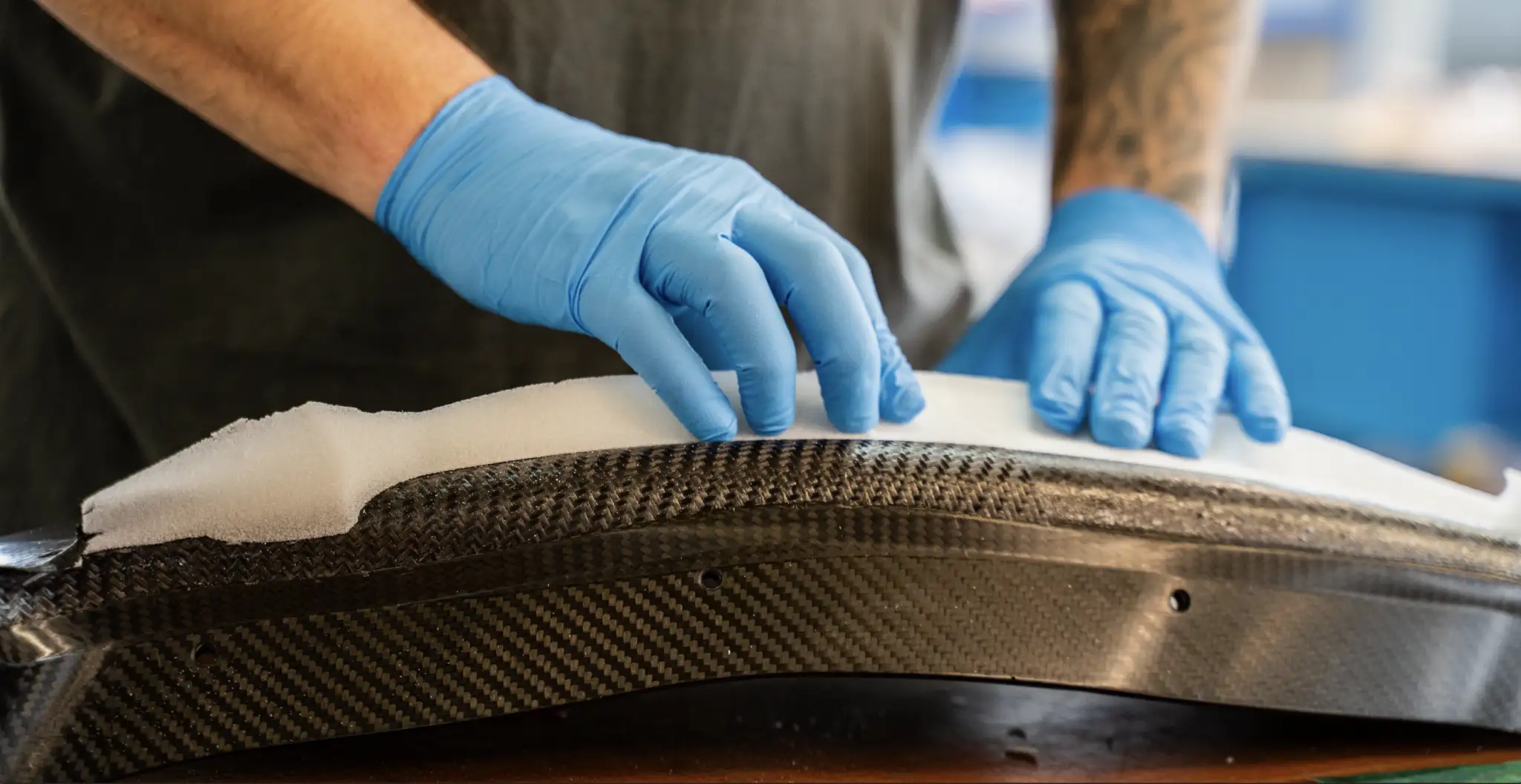
Composite Components

New Ways in Composites: being prototype or serial production, being Carbon, Glass, Aramid, or natural fibres, Connova Group manufactures composite components in perfection.

We realize your ideas and plans until full product maturity. Our experience, our drive for innovation and our versatility guarantees high-quality products without compromise.

We bring the extra-ordinary material properties of composites literally to carry loads.

Composite components

Structural components

Sandwich shells/panels

Drawing parts

Construction elements

Visible carbon components

etc.

Materials

Carbon fiber (CFRP)

Glass fiber (GFRP)

Aramid fiber (AFK), such as Kevlar

Natural fibers such as flax or hemp

Thermosetting resin systems

Special solutions on request

Advantages of Composites

Fiber composite components and components have excellent properties – the engineers at Connova Group use these to realize your requirements and wishes

Strength

Not achievable with conventional materials – with comparatively low weight!

Stiffness

Adjustable stiffness in every direction – from elastic to highly rigid – allows endless application possibilities

Weight

Fiber-reinforced plastics offer unmatched lightweight potential compared to metallic solutions

Fatigue strength

Fiber composite structures fatigue much more slowly and allow a longer service life

Damping

In a dynamic environment, vibration damping is up to ten times higher than with metals

Thermal expansion

Controlled and adjustable thermal expansion up to zero expansion!

Chemical resistance

Very high resistance to many chemicals guarantees use in difficult environments

X-ray transparency

Radiation permeability allows use in medical environments with the highest requirements

Design

Fabric structure looks appealing & high-quality and offers new design options

Properties of Composites

Properties

Fiber type:

HT carbon fiber

Matrix type:

Epoxy resin

Fiber volume fraction

60%

– All values are typical average values

Elasticity values

E-modulus in fiber direction

140 GPa

E-modulus transverse to fiber direction

12 GPa

Shear modulus (G modulus)

5 Gpa

Transverse contraction (Poisson's ratio)

0,26

Density

p

1.55 – 1.60 g/cm2

Strength values

Tensile strength in fiber direction

2,100 MPa

Tensile strength transverse fiber direction

50 MPa

Compressive strength in fiber direction

1,500 MPa

Compressive strength transverse fiber direction

230 MPa

Shear strength

90 Mpa

Thermal expansion coefficients

Expansion in fiber direction

0.2 x 10⁻⁶ K-1

Expansion transverse fiber direction

30 x 10-6 K-1

Download

Download the presentation as a PDF file.