






Composites for Space

Very light and ultra-stiff carbon fiber composite structures are the standard for demanding structures in the space industry.

ESA
MT-Aerospace
Thales_Alenia_Space
Almatech
Beyond Gravity
unibern0v2
University of Zurich

KNOW-HOW

15 years of experience in space travel
COMPOSITES

Ultra-rigid structures for the harsh conditions in space

INDIVIDUALITY

Project-specific solutions according to customer requirements

15+

Years of Heritage in European Space Programmes
Source · Connova Group

~10⁻⁷

Coefficient of Thermal Expansion (CTE) in CFRP, tailored through fiber orientation for maximum dimensional stability

1.5 m³

Typical Build Volume for Space Structures at Connova

ESA SME

Status: Recognized ESA Supplier for Key European Space Missions
Source · European Space Agency

High-performance components for the space industry

The Connova Group has also been active in space travel for over 15 years. With our lightweight and highly rigid composite components, we increase the payload capacity of launch vehicles and build structures for particularly light satellites and spacecraft. We have a broad space heritage and impress with project-specific solutions.
Excellence in space

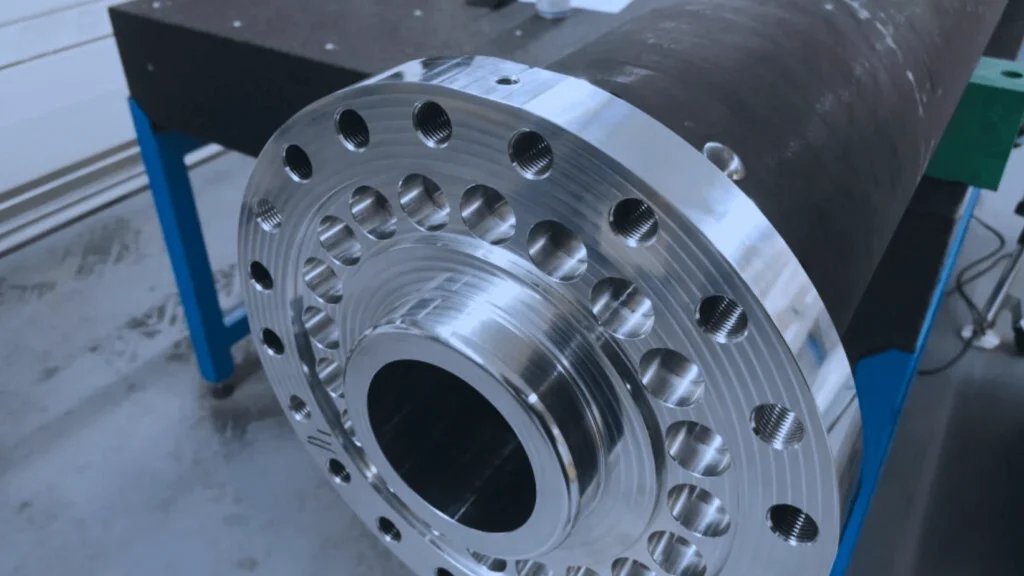
We have many years of experience in the development and production of space structures made of composite or titanium components. Regardless of whether particularly high mechanical or special thermo-mechanical requirements are required for the harsh conditions in space – our engineers already know the solution or are developing it together with the customer.

Our Portfolio of Space & Spacecraft Components

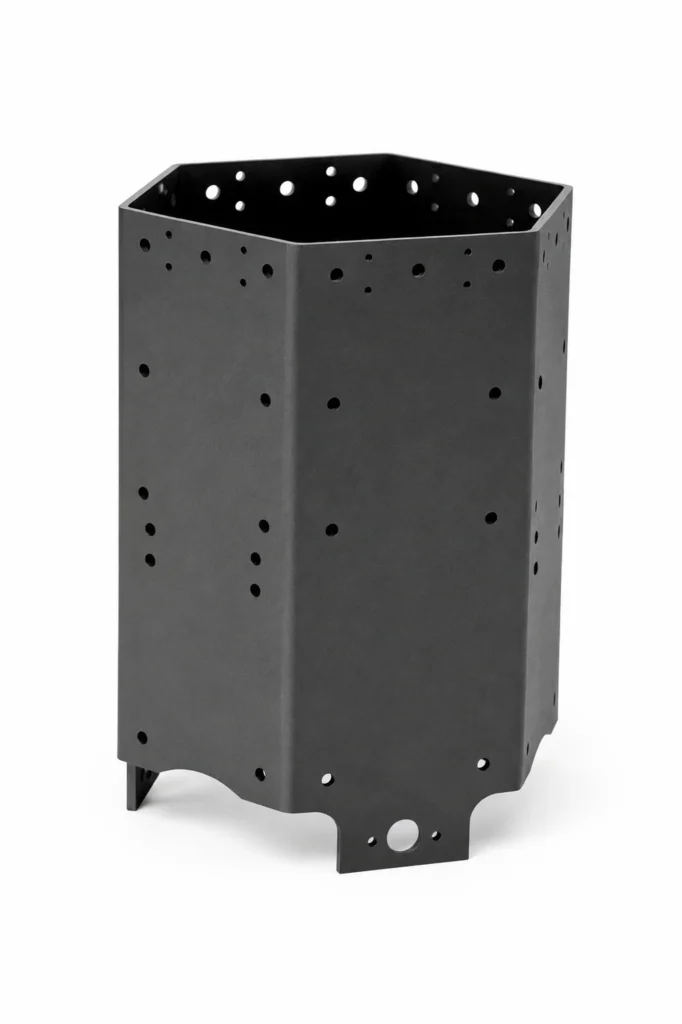
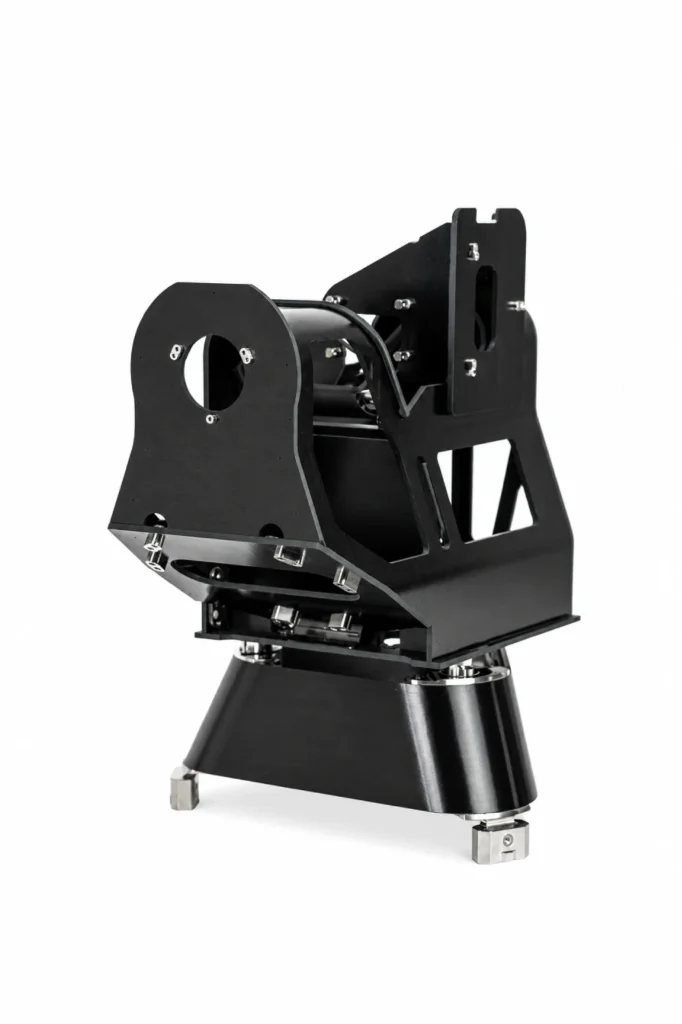
Our portfolio ranges from satellite primary structures and high precision telescope frames to reusable launcher components. Every component is engineered for its specific mission and developed by Connova from concept through to flight qualified hardware.

RAMSES – CHANCES Telescope Structures

Primary Structures for Satellites

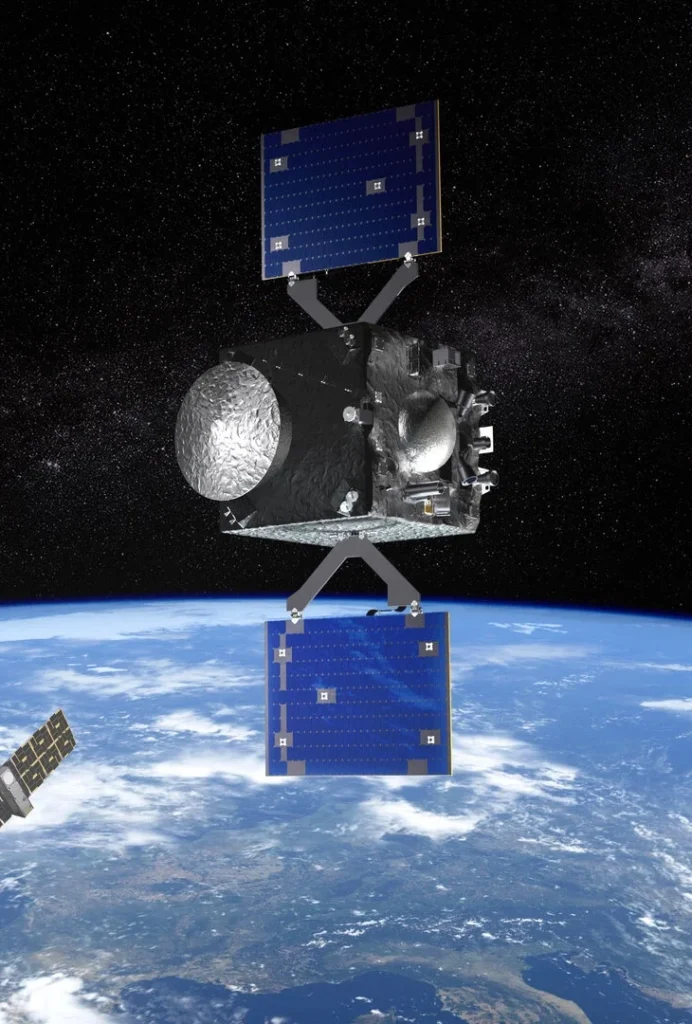
The main load bearing structure of a satellite, serving as the structural backbone to which all subsystems are attached. Manufactured from CFRP or titanium composite hybrid materials, featuring qualified bonding processes and integrated inserts for subsystem interfaces. Connova manufactured, among others, the complete primary structure for the ESA Aeolus Aladin satellite (STM and PFM models).

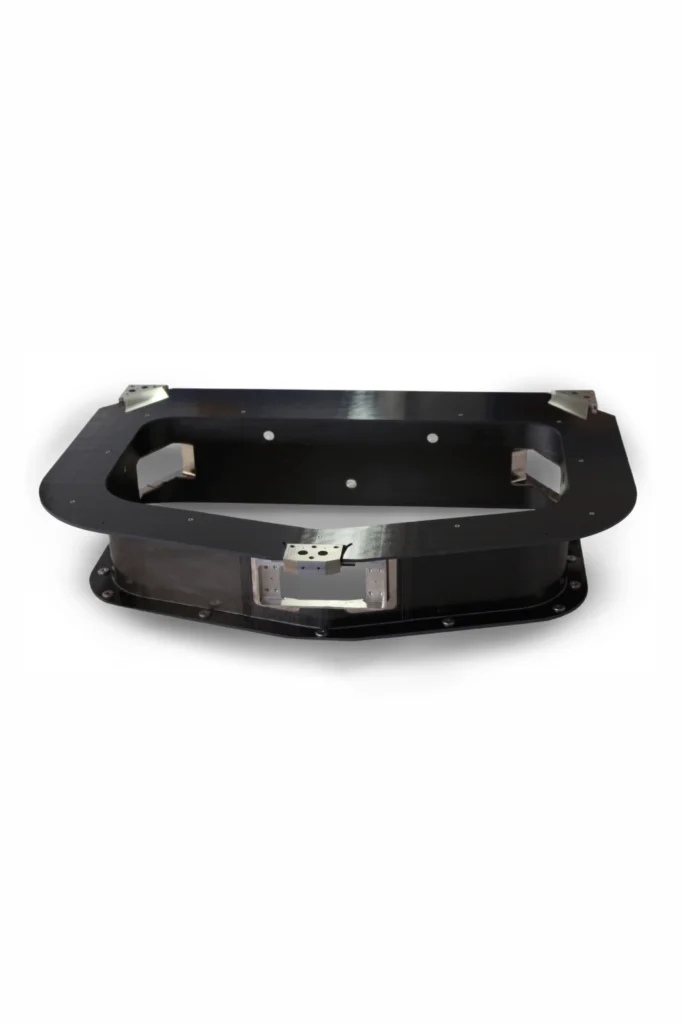
CO2M (Sentinel 7) — Teleskopstruktur

Telescope Structures

High precision CFRP support structures for space telescopes, including tube geometries, spider structures, and optical benches. Micrometer level stability across thermal cycles.

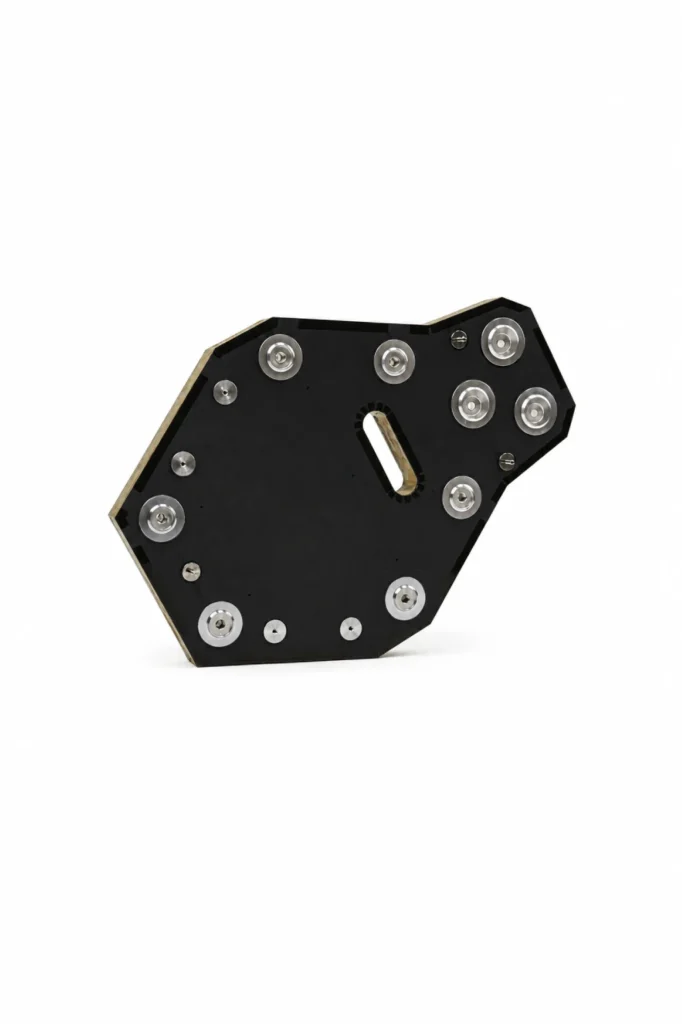
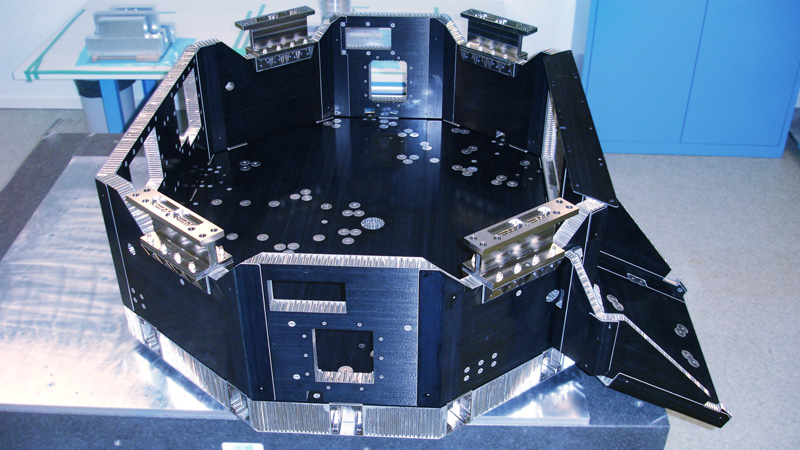
Comet Interceptor — CoCa Baseplate

Optical Baseplates

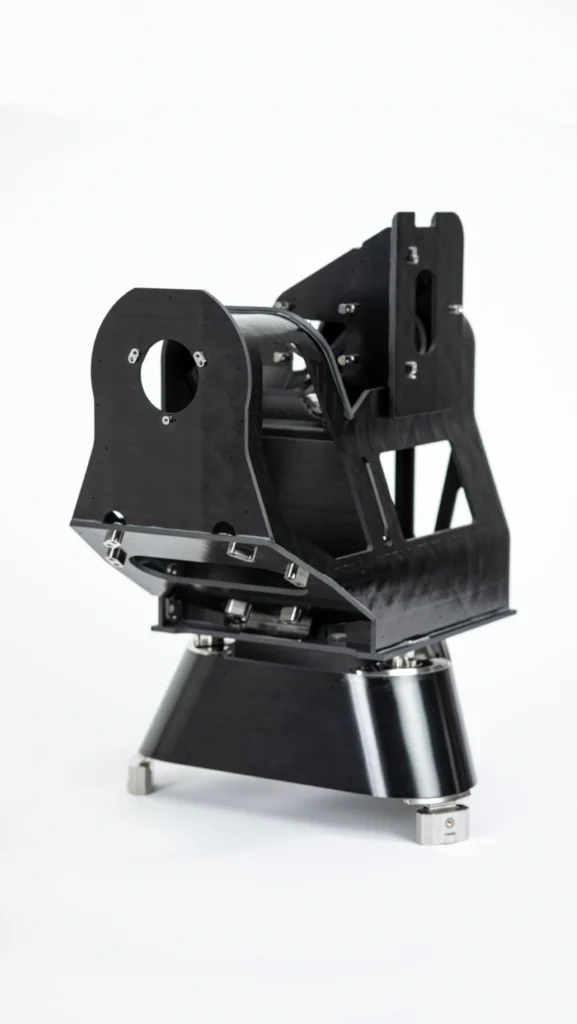
High precision CFRP platforms for scientific instruments. Structural baseplates for optical components with micrometer level tolerances.

Mirror Mounts

Mirror Mounts

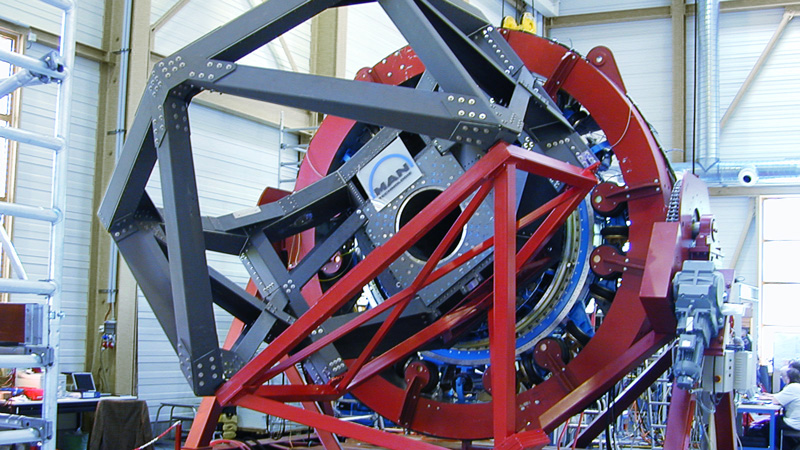
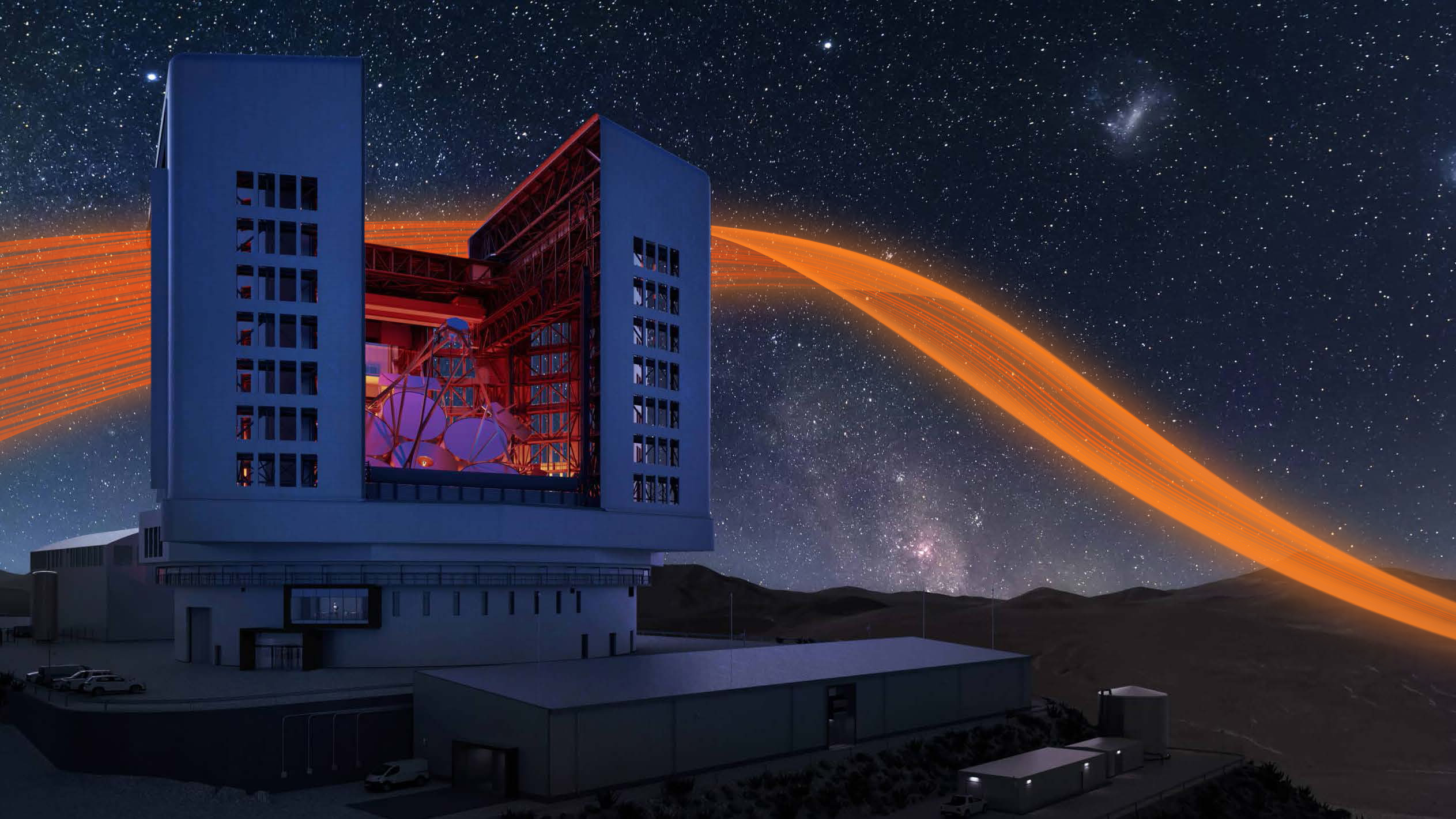
Mounting structures for primary and secondary mirrors, ranging from large telescopes such as the Giant Magellan Telescope to satellite optics.

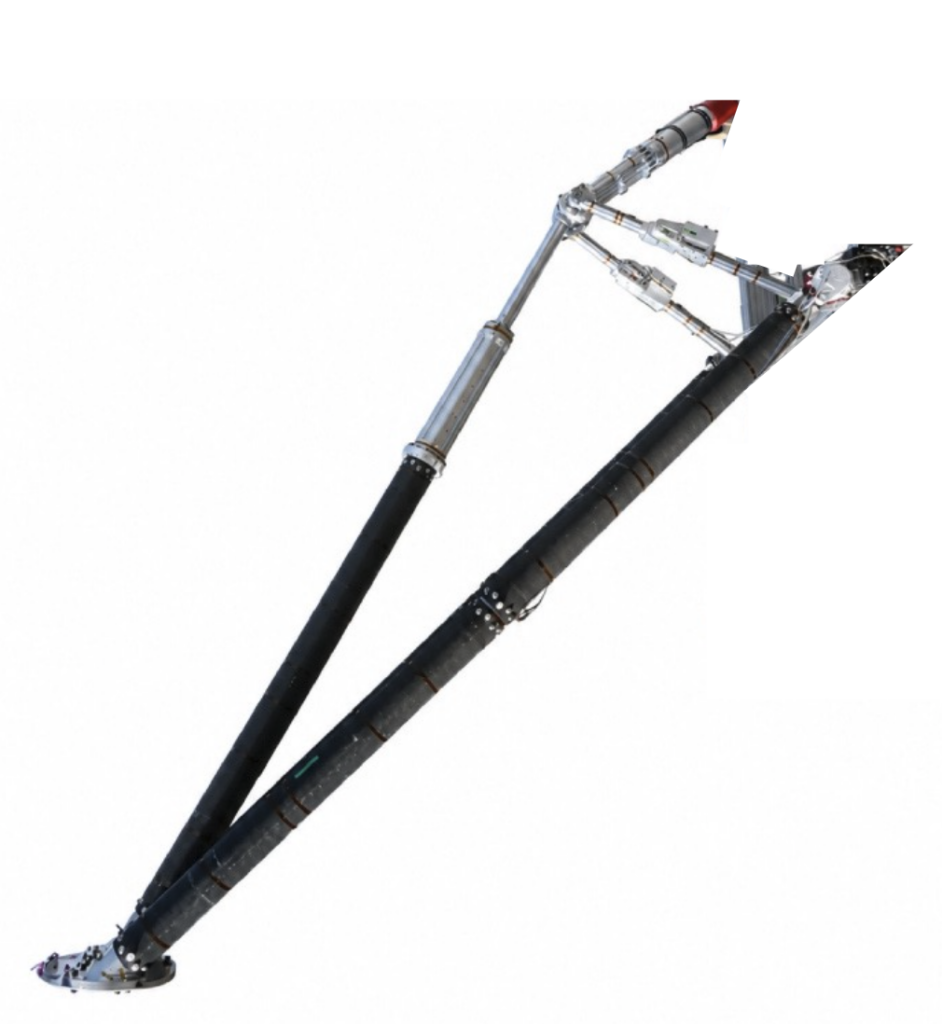
Launcher  Landebein Komponenten

Launcher & Landing Leg Components

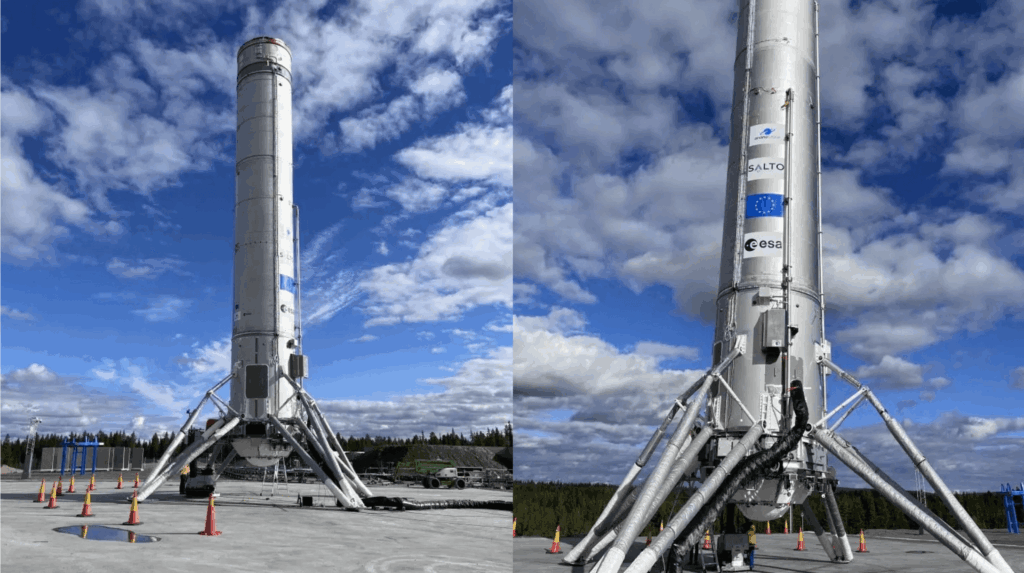
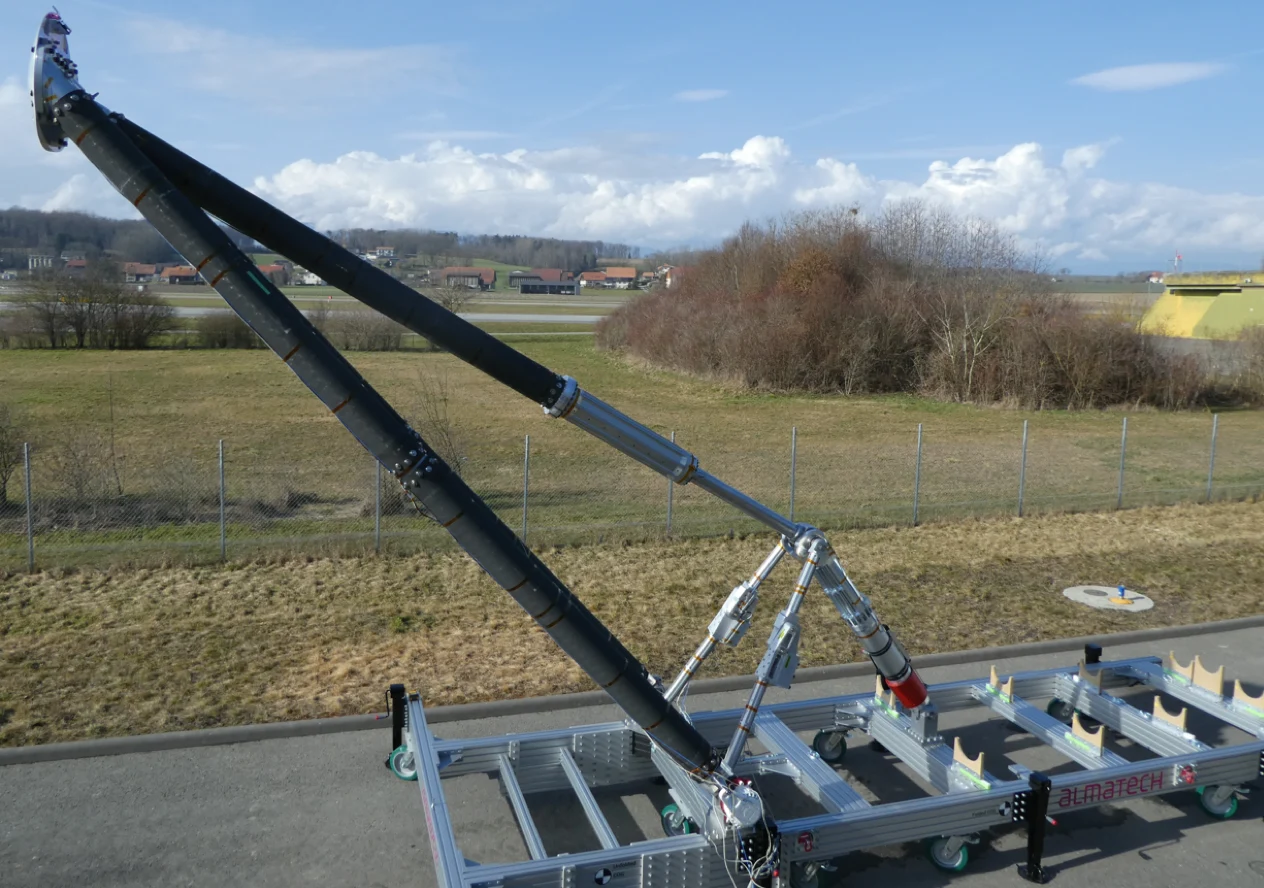
Structural components for launch vehicles and reusable launchers. Themis landing legs serve as a reference for the next generation of Ariane launch vehicles.

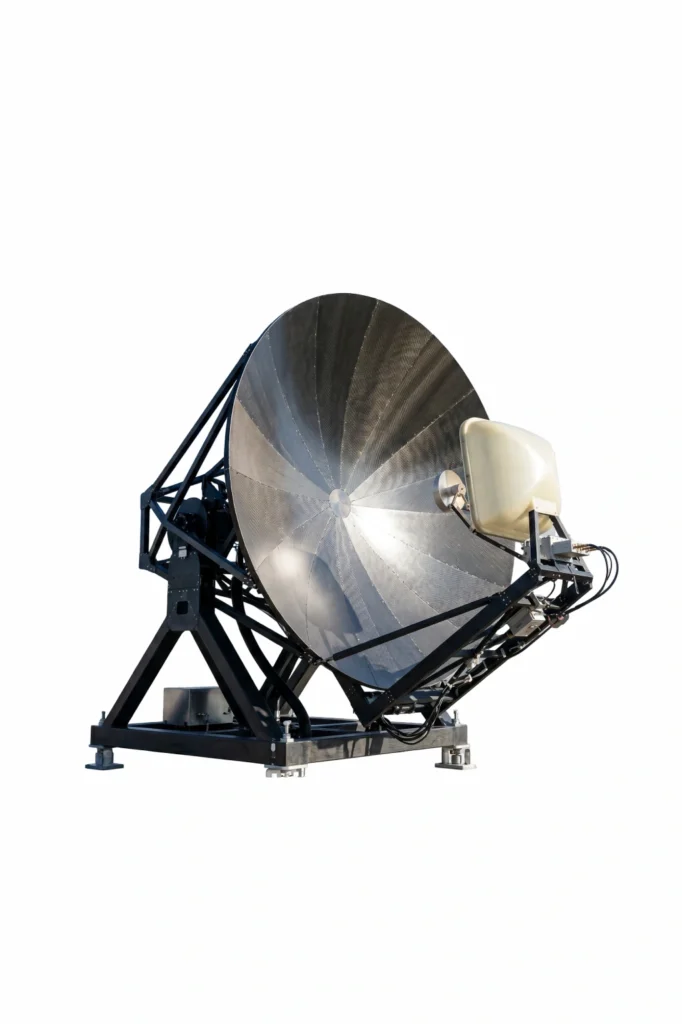
Antennen Reflektoren  RF Strukturen

Antenna Reflectors & RF Structures (Radomes)

GFRP and CFRP structures for antennas, high frequency components, and electromagnetically transparent applications.

Composite Materials for Space Applications

In space, material selection determines mission success. Vacuum, cosmic radiation, thermal cycles from -150 °C to +120 °C, and extreme vibration loads during launch all require different fiber and matrix combinations.

Reinforcement Fibres

Fibre System

Applications

Key Properties

HT Carbon Fiber (High Tensile)
Secondary structures, satellite interior components
Cost effective · widely qualified material
IM Carbon Fiber (Intermediate Modulus)
Primary structures, tube geometries
High specific stiffness · aerospace qualified
HM (High Modulus) e.g. M55J
Stability critical components, optical benches
Maximum stiffness · premium applications
Glass Fiber (E-Glass / S-Glass)
Radomes, antenna covers
Electromagnetically transparent · high impact resistance

Matrix Systems

Matrix System

Service Temperature

Key Properties

Epoxy resin
up to ~180 °C
Industry standard for structural applications
Cyanate Ester (CE)
up to ~230 °C
Lowest moisture absorption · maximum dimensional stability
BMI Bismaleimide
up to ~230 °C
Higher glass transition temperature · for thermally loaded structures
Phenolic
up to ~200 °C
Excellent fire, smoke, and toxicity performance · cabin interior applications

Sandwich & Core Materials

Core Material

Construction Type

Properties

Aluminum Honeycomb

Metallic honeycomb core structure
High compressive strength · excellent crush performance
Nomex® Honeycomb
Aramid paper honeycomb
Lightweight · Self-Extinguishing · FST Compliant

Overview of Manufacturing Processes

Choosing the right manufacturing process is just as important as selecting the right material. We offer the full range of manufacturing technologies in house and select the most suitable process for each project based on geometry, production volume, and performance requirements.

Manufacturing Processes

Best Suited For

Surface Quality

Production Volume

Tooling Cost

Connova

Prepreg Autoclave
Primary structures, highly loaded components
Single-sided Class A surface
Low to Medium
Medium

RTM (Resin Transfer Molding)

Complex integrated geometries
Double-sided Class A surface
Medium to High
High

Hot Press Molding

Repeatable secondary structures
Double-sided Class A surface
High
Medium
Winding technology
Cylinders and pressure vessels
One-sided
Medium to High
Low to Medium
Vacuum Infusion
Large monolithic structures
One-sided
Low to Medium
Low
Wet Layup
Prototypes, repairs
One-sided
Low
Very Low

Our core competencies in the space industry

SPACE: ENGINEERING & DEVELOPMENT

Specialized in your needs

As specialists for composite material solutions in space travel, we offer an extensive portfolio of services: from consulting and product development in the space sector to the design and analysis of space components and the optimization of space systems.

SPACE: COMPOSITES

Production of fiber composite components

Thanks to our many years of expertise in the production of high-performance composites for space travel, our experts ensure the most effective manufacturing method for your space product, always maintaining the highest quality standards and reliable delivery.

SPACE: CNC MANUFACTURING

Exact precision for optimal end products

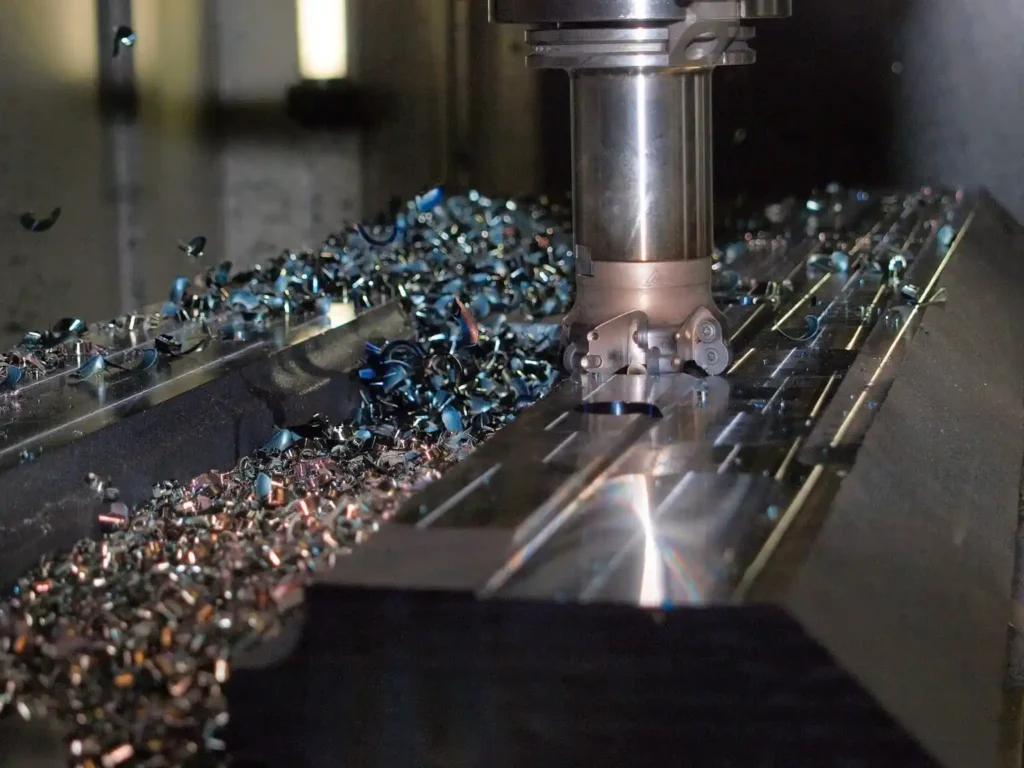
We offer a wide range of CNC services specifically for model making, mold making and final machining of composite components in the aerospace industry, always with a 100% guarantee of accuracy.

SPACE: EDITING & SUPPORT

From the manufacturing process to final production

We offer a comprehensive range of machining and support services that can serve as an integral part of the manufacturing process of your aerospace composite components, as well as provide complementary support for your own manufacturing.

Mission Programmes & Space Heritage

Our components are used in key European space missions, ranging from Earth observation and exoplanet research to planetary defense. Due to confidentiality agreements, specific component scopes are often undisclosed. The programme categories below illustrate the breadth of our expertise and the diversity of the platforms we support.

Reusable CFRP landing legs

Earth Observation Missions

  • Aeolus Aladin (ESA) – Primary Structure
  • CO2M / Sentinel-7 – Telescope
  • Additional Earth Observation Platforms – Various
Weitere Segmente Luft und Raumfahrt. Anwendungen von Composites in Triebwerken, Satelliten, Flugzeugen und Raumfahrzeugen

Scientific Missions

  • CHEOPS (ESA) – Exoplanets
  • SOFIA (DLR/NASA) – Mirrors
  • Giant Magellan Telescope – Bezels
RAMSES – CHANCES Telescope Structures

Asteroid Missions

  • RAMSES / CHANCES – Apophis
  • ESA Space Safety Programme – Various
CO2M (Sentinel 7) — Teleskopstruktur

Deep Space Missions

  • Comet Interceptor — CoCa Baseplate
  • F-Class ESA Mission – 2029+
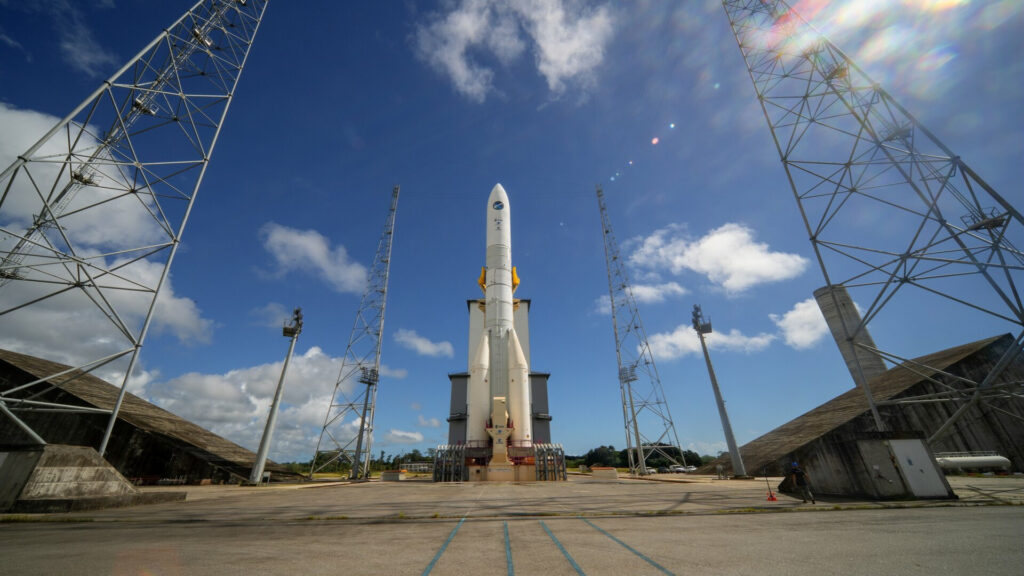
Ariane 6 (Hightex) – Structures

Launch Vehicles

  • Themis T1H (Almatech) – Landing Legs
  • Ariane 6 (Hightex) – Structures
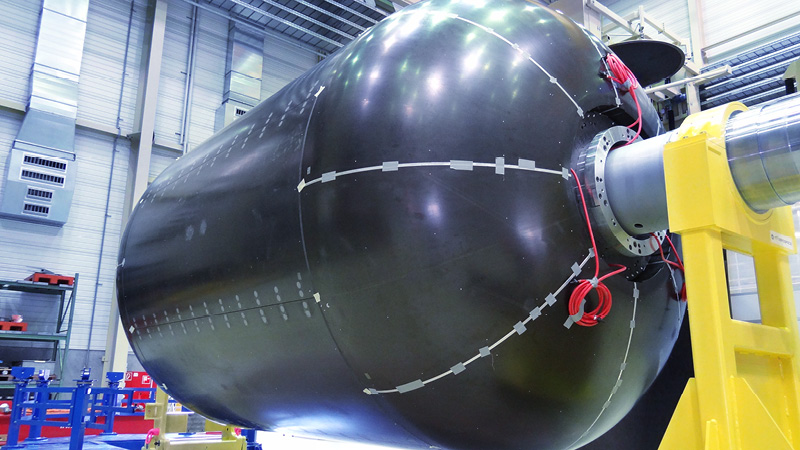
  • MT Aerospace FEMI Filament Winding – Propellant Tank
Mechanische Eigenschaften von CFK Laminaten. Vergleich CFK vs. Aluminium Zugfestigkeit 1500 2000 MPa, Modul 230 GPa, Elastizitätsmodul

Tools & Fixtures

  • High Temperature Lamination Molds – ESA Programmes
  • Vacuum Fixing Jigs – Multi Use
  • Assembly and Trimming Aids – Various

From Concept to Space Qualified Hardware

Every space project follows the same four stage process. This ensures a seamless path from the initial concept to qualified flight hardware, with a single point of contact throughout all project phases.

Feasibility & Consulting

Technical analysis, material selection, and manufacturing strategy. Initial effort and timeline estimation.

Engineering & Analysis

FEA simulation, lay-up optimization, and tooling concept. Load and lifetime verification.

Prototyping & Process Development

First article manufacturing, FAI documentation, material testing, and non-destructive testing (NDT).

Qualified Series Production

Manufacturing under EN 9100, continuous quality monitoring, and on time delivery.

Why Choose a Swiss Composite Partner for Space Applications

Swiss engineering and space composites are a natural fit because both demand uncompromising precision. These four differentiators make the difference in European space procurement.

ESA SME Status

Recognized ESA supplier with more than 15 years of heritage in key European space missions.

Materials Expertise

Especially in the space environment, success depends on making the most of the unique strengths of each material.

Full Traceability

Every process step and every material batch is fully documented throughout the entire lifecycle of the component.

Complete End to End Solution

From material sourcing and finishing to laminates, assembly, precision machining, inspection, and bake-out, everything is provided from a single source.

Your Point of Contact

Taylan Toprak

Head of Sales & Project Management, Connova Group

Taylan Toprak is a graduate aerospace engineer (TU Munich, graduated in 1993) with over 30 years of experience in aerospace engineering. As Head of Sales & Project Management at the Connova Group, he is responsible for business development and project management – including in the space segment, where the company has been active for over 15 years. The Connova Group supplied composite structures for the ESA CHEOPS mission and is developing CFRP landing legs for reusable launch vehicles (Themis/Almatech).

Why you benefit from his expertise:

  • International NASA/ESA Experience: From 1997 to 1999, he was permanently co-located at the NASA Johnson Space Center in Houston, Texas, as part of a 15-person international ESA team. Working right where astronauts train and Mission Control is based, he was one of four design engineers responsible for the structural engineering and CAD design of the aft structure for the X-38 program (the planned lifeboat for the ISS).
  • Space Heritage: The Connova Group is a long-standing supplier for European space programs – including composite structures for the ESA exoplanet mission CHEOPS and CFRP mirror mounts for the Giant Magellan Telescope.
  • Reusable Rocket Technology: Development and manufacturing of innovative CFRP landing legs for the Themis launch vehicle (Customer: Almatech) – a key contribution to the reusability of European launchers.
  • Mastering Extreme Conditions: Experience with space-grade materials and processes that reliably withstand vacuums, thermal cycles, and high mechanical loads.
  • End-to-End Support: From the initial feasibility study and prototyping to qualified flight hardware – an experienced partner for the entire value chain.


“Spaceflight demands absolute reliability at minimum weight. With the Connova Group’s over 15 years of space experience and my personal background in aerospace engineering, we guide our customers from concept to flight-qualified hardware.” — Taylan Toprak, Head of Sales & Project Management, Connova Group

Silvan Ventura

Project Lead Space Structures · Connova Group

Over 10 years of experience manufacturing high precision CFRP structures for space applications. Responsible for telescope structures and optical baseplates, including current projects such as Comet Interceptor (CoCa Baseplate), CO2M (telescope structure), and RAMSES/CHANCES (telescope structures for the Apophis companion mission).

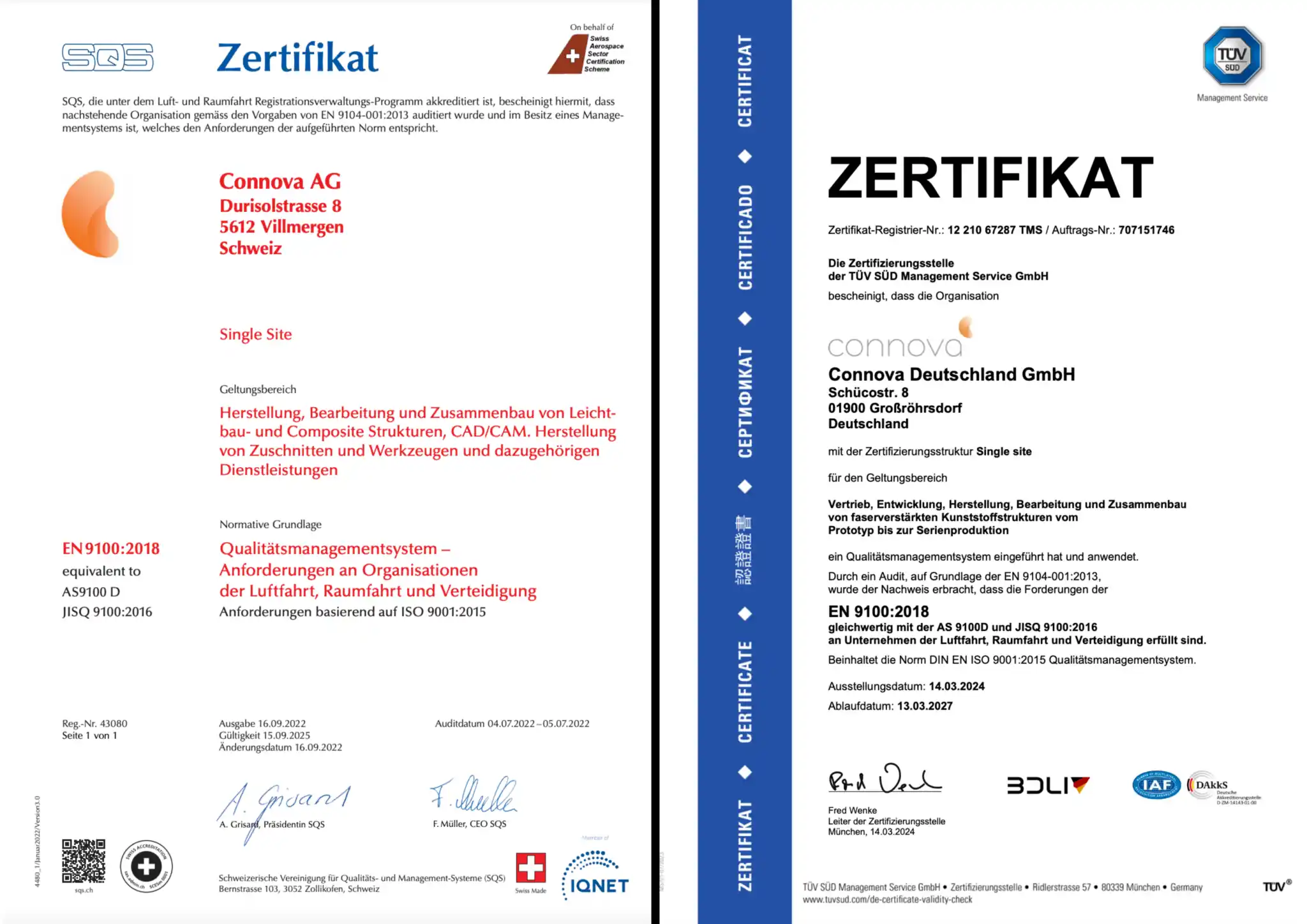
EN9100 certification meets top performance in the aerospace industry

In addition to our standard ISO 9001 certification, we proudly maintain our higher level EN9100 quality management certification for the aerospace industry. We guarantee controlled, measurable quality from material procurement to delivery of the end product. With our high-precision testing equipment, we meet the highest industry standards. Trust us when it comes to precision and consistent quality assurance.

Our Space Success Stories

The Connova Group supplies main components for Themis rocket landing leg system.

The Connova Group was responsible for the development of the manufacturing processes and the production of four complete landing legs for a demonstrator of a future launch vehicle as part of the Themis project.

The project, commissioned by Almatech and ArianeGroup, aims to develop technologies for cost-effective, reusable rockets to be operational after 2030 as the successor to Ariane 6.

The Connova Group manufactures CFRP mirror mounts for the Giant Magellan Telescope.

The Connova Group developed and manufactured high precision CFRP mirror mounts (bezels) for the Giant Magellan Telescope (GMT), one of the most ambitious scientific projects of our time. The exceptional dimensional stability and low coefficient of thermal expansion of carbon fiber composites are essential for maintaining the precise positioning of the optical components throughout all temperature cycles. Located at the Las Campanas Observatory in Chile, the GMT features a primary mirror composed of seven segments, making it one of the world’s largest telescopes. Commissioning is planned for the early 2030s.

Frequently Asked Questions About Space Composites

What Are Space Composites?

Space composites are advanced fiber-reinforced materials, typically carbon fiber reinforced polymers (CFRP), qualified for operation in the space environment. They combine minimum weight with exceptional specific stiffness and proven performance under vacuum conditions, cosmic radiation, and thermal cycling.

ESA SME is the designation awarded by the European Space Agency to small and medium-sized enterprises qualified to supply European space programs. Connova has maintained this status for many years, enabling direct contracting with ESA as well as Tier 1 integrators such as Thales Alenia Space and Almatech.

We work with the full spectrum of aerospace-qualified composite systems, including standard-, intermediate-, and high-modulus carbon fibers (e.g., M40J, IM7), glass fibers for radome applications, matrix systems ranging from epoxy resins to BMI and cyanate ester, as well as sandwich structures with Nomex® or aluminum honeycomb cores.

Low Outgassing refers to the requirement that materials release only minimal amounts of volatile substances when exposed to vacuum. In space, these substances could contaminate sensitive optical surfaces, including mirrors, lenses, and detectors, potentially compromising mission performance. We qualify our material systems according to the ESA standard ECSS-Q-ST-70-02.

Our standard component size for space structures is approximately 1.5 m³. For flat geometries, larger lengths and widths are also possible with composite manufacturing.

Send us your technical specification, CAD model, or sketch along with the mission context via our contact form or directly to Taylan Toprak (Head of Sales) or Silvan Ventura (Project Lead Space Structures). You will receive an initial technical assessment within a few business days.

The complete set of 10 questions with detailed answers can be found in the accompanying briefing document.

Space Composites Glossary

A reference glossary of the most important terms in space composite engineering, useful for procurement, project management, and technical evaluation.

Carbon Fiber Reinforced Polymer

A composite material made of carbon fibers embedded in a polymer matrix. The standard material for space structures, offering exceptional specific stiffness.

Glass Fiber Reinforced Polymer

A composite material made of glass fibers embedded in a polymer matrix. The standard material for radome related and electromagnetically transparent applications.

ESA SME Status

European Space Agency status for recognized SME suppliers in European space programmes.

EN 9100

Aerospace Quality Management System standard based on ISO 9001, with additional aerospace specific requirements.

Outgassing

The release of volatile substances in a vacuum. Critical due to the risk of contaminating optical surfaces. Standard: ECSS-Q-ST-70-02.

Bake-out

High-temperature thermoset matrix system. Service temperature up to ~230 °C, used for engine area and high-temperature aerospace applications where epoxy is insufficient.

Coefficient of Thermal Expansion (CTE)

A measure of how much a material changes in length per unit of temperature. In CFRP, the CTE can be tailored through the laminate lay-up, making it critical for optical stability.

Cyanate Ester

Documented verification that a manufactured part meets all engineering and quality requirements. Mandatory step before transitioning from prototyping to certified series production.

First Article Inspection

Documented inspection of the first article to verify compliance with all specifications. A mandatory step before series production.

Non-Destructive Testing

Inspection methods (ultrasonic testing, X-ray, thermography) performed without damaging the component. Mandatory for primary structures.

Honeycomb Sandwich

A construction consisting of two composite face sheets bonded to a honeycomb core (Nomex® or aluminum), providing the highest stiffness-to-weight ratio.

Fire, Smoke & Toxicity (FST)

Performance requirements for aircraft cabin interiors: low flame spread, low smoke emission, and low toxicity.

Non-binding advice for space travel solutions

Mit grosser Expertise, gewonnen aus zahlreichen Projekten im Bereich des Leichtbaus über mehrere Jahrzehnte, stehen wir bereit, Ihre Visionen zu realisieren. Kontaktieren Sie uns für ein professionelles Beratungsgespräch, in dem wir gemeinsam erörtern können, wie wir als Ihr potenzieller Partner fungieren können. Unser Beratungsservice ist selbstverständlich kostenlos und ohne jegliche Verpflichtung für Sie.

Aktuelle Neuigkeiten