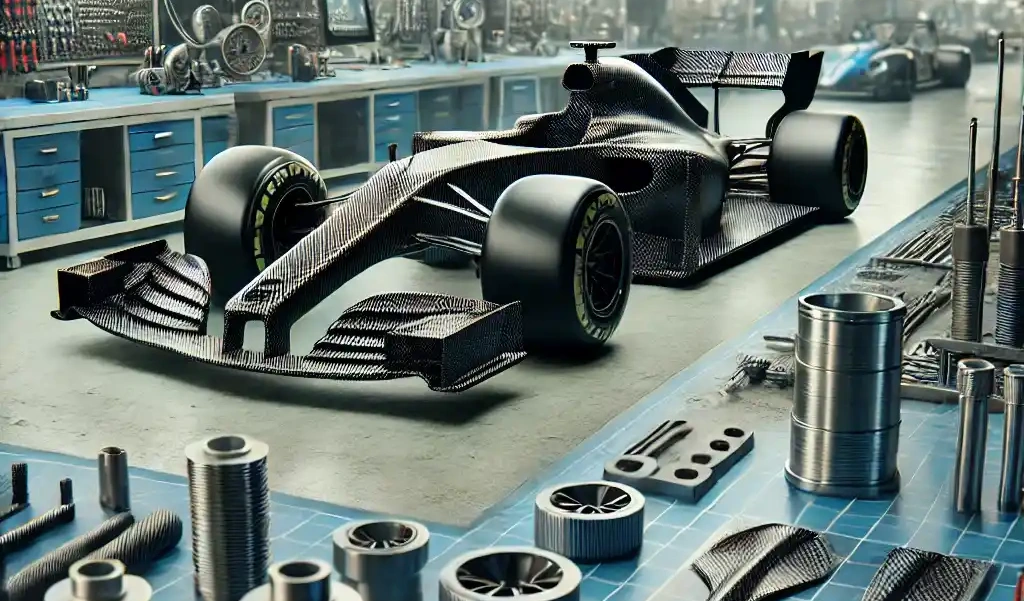
KNOW-HOW

Experience in motorsport, especially Formula 1, as well as premium, tuning and special vehicles

COMPOSITES

Less weight, stiffer body, better performance

INDIVIDUALITY

Implementation of orders within the shortest possible time

Racing and automotive industry

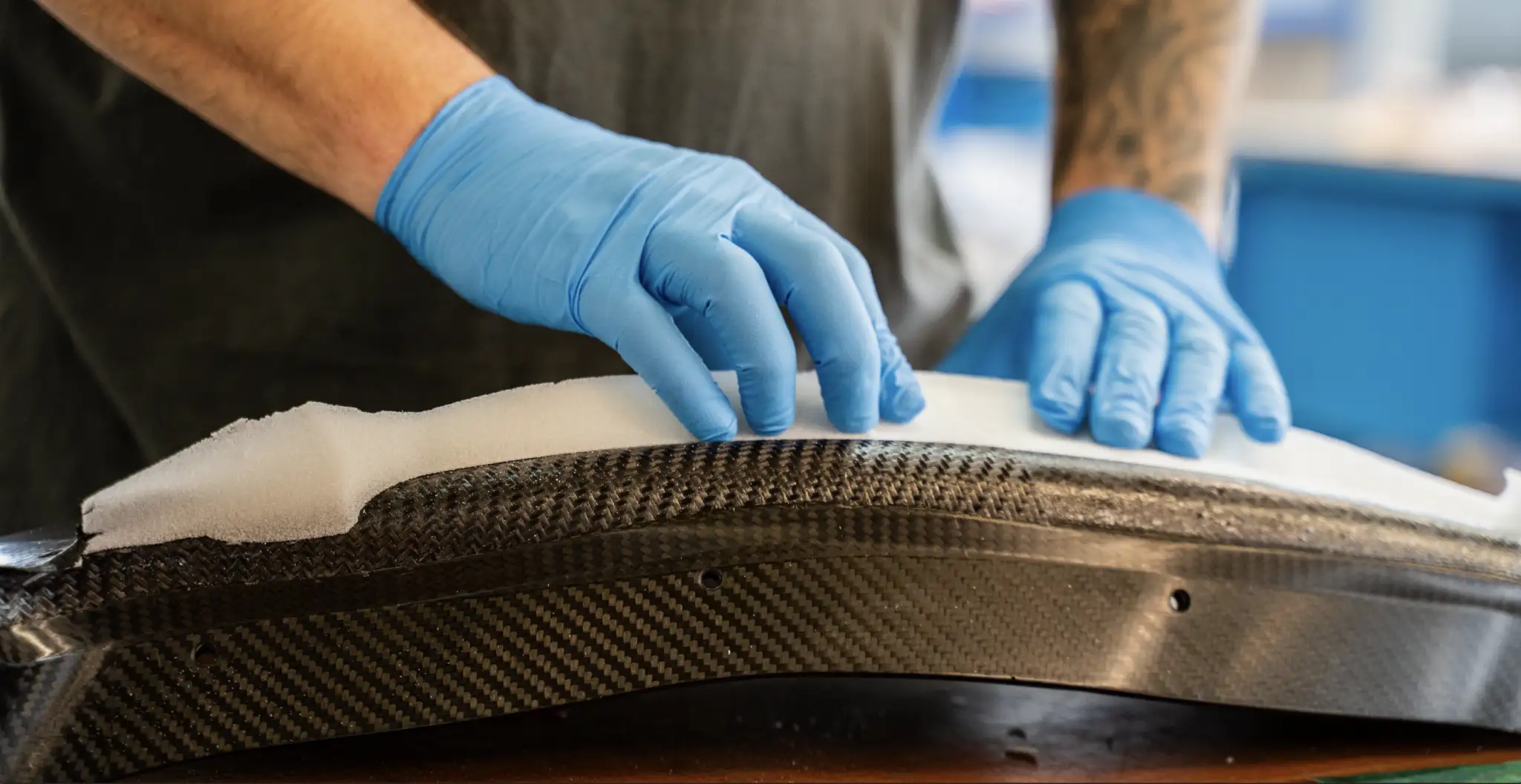
Lightweight yet rigid composite components have become indispensable in motorsport and the automotive industry. We have been manufacturing components for a Swiss Formula 1 team for many years. In other racing series, as well as for premium, tuning and special-purpose vehicles, we have built up extensive know-how and a broad wealth of experience in composite applications over the years. This enables us to meet the most demanding product and process requirements even at very short notice – customized and certified.

When Composites Make Economic Sense in Automotive Manufacturing

Not every component is improved by using fiber-reinforced composites. The decision depends not on the material, but on the load case, the required stiffness, and the production volume.

Composites demonstrate their strengths in applications where mass is moved or accelerated, where stiffness needs to be adjusted depending on the direction, or where thermal expansion is a problem. Carbon fibers can be laid along the load paths. A CFRP component is therefore not simply a replacement part made from a different material, but a different design—and must be engineered as such from the very beginning.

A Comparison of Materials Used in Automotive Manufacturing

Criterion

CFRP

Aluminum

Steel

Density

approx. 1.5–1.6 g/cm³

approx. 2.7 g/cm³

approx. 7.85 g/cm³

Stiffness per Unit Mass

very high, can be designed to be directional

medium

medium

Thermal expansion

Adjustable from near zero to values typical for the material

high

medium

Behavior Under Alternating Loads

very good

limited

good

Corrosion

None; be aware of contact corrosion at metal connections

Protective coating required

Protective coating required

Joining Technology

Adhesive bonding, embedded inserts

Welding, Riveting, Bonding

Welding, Screwing

Economically Feasible Production Volume Range

From a single unit to about 10,000 units per year

medium to high quantities

large quantities

The density values are guidelines for the material groups. The project-specific parameters depend on the fiber type, matrix system, and layer configuration, and are determined during the design phase.

When We Do Not Recommend Composite

We will give you this assessment even if it argues against placing an order with us. That is why every project starts with a feasibility analysis – not a quote.

Structural Parts and Components for Automotive and Motorsport

Which automotive components we manufacture for vehicle manufacturers, racing teams and Tier 1 suppliers, using which process, and in what typical batch size.

Component

Function in the Vehicle

Typical Process

Batch Size

Heat Shield

Thermal shielding in the engine compartment and along the exhaust system

Prepreg Autoclave

Series Production

Aerodynamic Assemblies

Downforce, airflow management, underbody and diffuser

Prepreg Autoclave

Small to medium series

Race Car Structural Components

Load bearing and stiffness around the chassis

Prepreg Autoclave

One-offs to small series

Body and Exterior Components

Visible outer skin in Class A quality

Prepreg, RTM

Small series

Rotor Bandages and Sleeves

Centrifugal retention of the magnets in electric motors

Winding Technology

Series Production

Containment Shells

Separation of rotor and stator in pumps and auxiliary units

Prepreg, RTM

Series Production

CFRP Plates and Cut-to-Size Parts

Semi-finished products for fixtures, panels and fittings

Hot-press technology

Series Production

Fixtures and Gauges

Dimensionally stable production aids for the customer’s own manufacturing

Toolmaking, CNC

One-off production

Tolerances

Tool-side contour accuracy typically ±0.2 to ±0.5 mm depending on component size; CNC-machined mating surfaces and hole patterns down to ±0.05 mm. We define the tolerance chain together with you before the tool is designed.

Component Size

Individual components up to approx. 2,500 × 1,200 × 800 mm. We produce larger assemblies in segments and join them in our own assembly department.

Ready-to-Install Delivery

On request, we deliver ready to install: machined, painted, inspected and with inspection documentation. Manufacturing depth and assembly are all in-house.

From Strak to a Class A site

Visible outer-skin components have different requirements than load-bearing structures. The surface must not only carry the load but also match the released design surface – right down to the reflections.

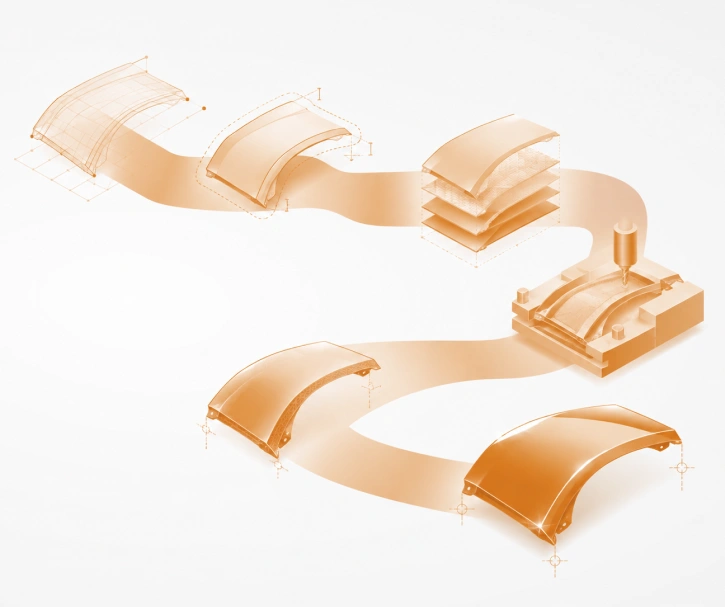
We take over the process chain from the released design surface: strak preparation, ply layup design, tool design and construction, manufacturing and surface finishing. Each of these steps changes the surface slightly – through shrinkage, springback and rework. Anyone who outsources these steps separately loses sight of this tolerance chain.

Strak preparation, ply layup design, tool design, toolmaking, manufacturing and surface finishing are all carried out in-house. Creating the design surface itself remains with you or your design studio – we take over once that surface has been released. For small series, prototypes and motorsport vehicles, this means one point of contact from the surface to the painted component.

Design Surface

Strak

Laminate Layup

Tooling

Component

Surface Finish

Our core competencies in the automotive and racing industry

Our expertise and technologies in the use of composite materials enable us to offer industry-leading solutions specifically tailored to the needs of high-performance vehicles and racing cars. Here we present our key areas: from tailor-made development and manufacturing to comprehensive support and optimization.

AUTOMOTIVE: ENGINEERING & DEVELOPMENT

Tailored to Your Requirements

As experts in composite technologies for the automotive sector, we offer a wide range of services: this includes both consulting and product development for the automotive industry, including the design and analysis of vehicle components as well as the improvement of vehicle systems.

AUTOMOBIL: COMPOSITES

Manufacture of Fiber Composite Components

Unsere Spezialisten sichern durch ihre umfassende Erfahrung in der Produktion von Hochleistungsverbundwerkstoffen für den Motorsport die effizienteste Fertigungsweise für Ihr Automobilprodukt, stets unter Berücksichtigung strengster Qualitätskriterien und garantierter Zuverlässigkeit bei der Lieferung.

AUTOMOBIL: CNC-FERTIGUNG

Precision to the Hundredth of a Millimeter for Outstanding Products

Our offering includes an extensive portfolio of CNC services specifically tailored to pattern making, toolmaking and the final machining of composite components in the automotive industry. We guarantee the highest dimensional accuracy, down to a hundredth of a millimeter.

AUTOMOBILE: MACHINING & SUPPORT

From Production to Final Finishing

Our service portfolio covers all aspects of mechanical processing and support. This includes both essential contributions to the production process of your automotive composite components as well as additional support for your internal production.

Toolmaking for the Automotive Industry and CNC Manufacturing

Tools and components are made at the same site. That may sound like an organizational detail, but it determines schedules and tolerances: if a tool needs rework after the first part, it is done in days rather than weeks.

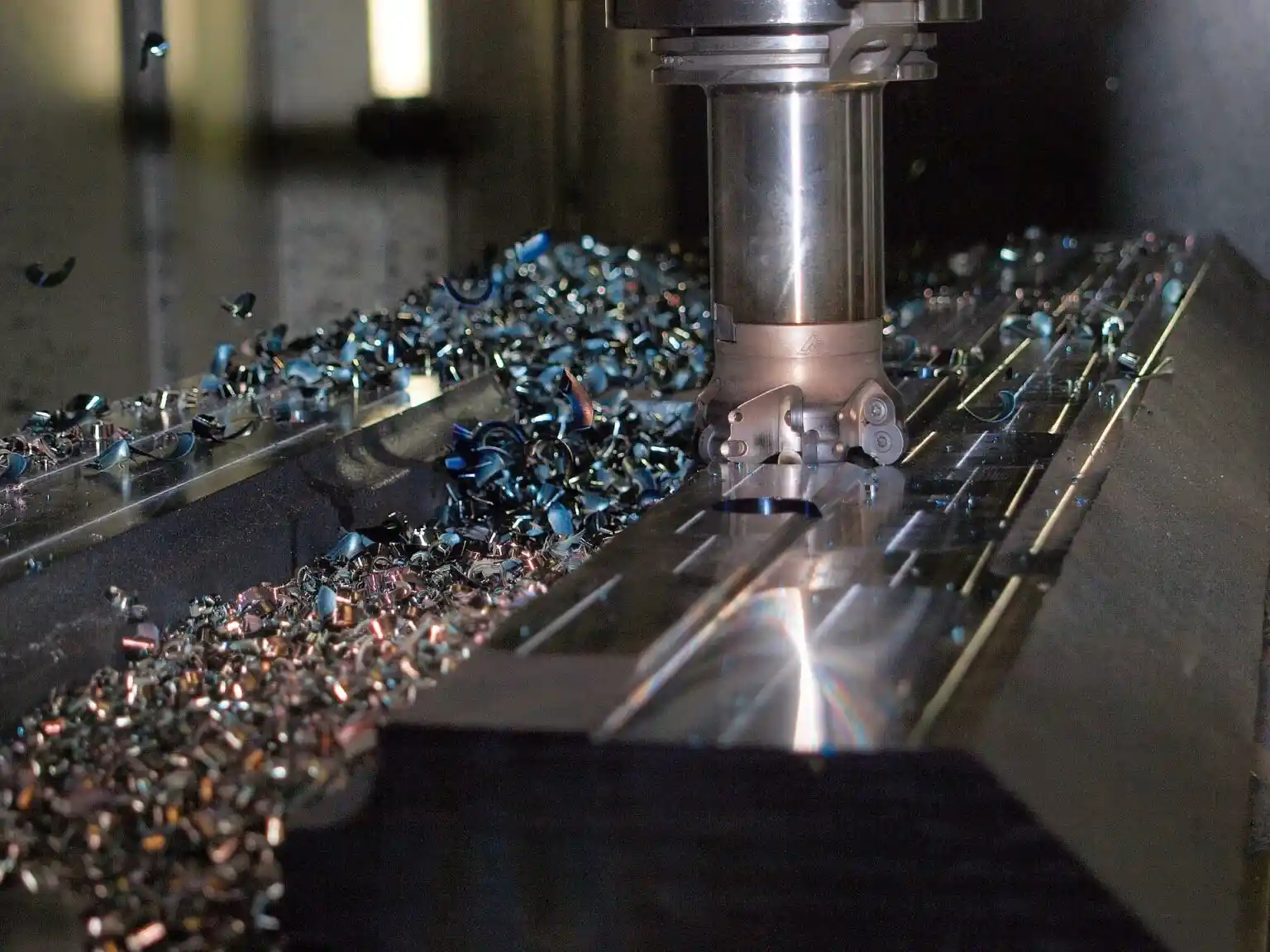
Our scope of services in mold making for automotive applications includes pattern making, tool and mold making, CNC milling of composite and metal components, and mechanical finishing. For customers who manufacture themselves, we also offer pure contract manufacturing – as a CNC supplier for automotive projects without their own composite requirements.

Overview of Manufacturing Processes

The process determines component quality, cycle time and tooling costs. We choose it based on the component and quantity – not on available capacity.

Procedure

Typical Components

Production Volume Range

Advantage in Vehicle Construction

Structural, aerodynamic and heat protection components

1 to approx. 5,000 units per year

High fiber volume fractions and reproducible properties

Flat and slightly curved components, plates

1 to approx. 10,000 units per year

Short cycle times for higher volumes

Rotationally symmetrical components, bandages, sleeves, containment cans

500 to over 100,000 units per year

Fiber orientation specifically designed for centrifugal loads

Components with defined surfaces on both sides

10 to approx. 10,000 units per year

Two tool surfaces, uniform surface quality

Large-area components and panels

1 to approx. 500 units per year

Lower tooling costs for small quantities

When designing a specific component, we usually compare two processes and disclose the cost calculation for both variants.

From Inquiry to Series Production — The Process in Eight Steps

Whether a one-off fiber composite part or a series component: the path is the same, only the scope of qualification differs.

Inquiry and Feasibility

We review the load case, installation space, quantity and target date and tell you whether composite is the right design approach.

Design and Calculation

Layup, fiber orientation and load introduction are designed and verified by calculation.

Process and Tooling Concept

Process, tool split and demolding concept are defined – together with production, not afterwards.

Toolmaking

Pattern and tool are made in-house. This keeps rework after the first component short.

Prototype and Testing

The first component is measured and inspected. Deviations are fed back into the tool and process.

First Article Inspection

Documented approval with measurement and material certificates. The standard is the first article inspection report according to EN 9102, on request according to VDA Volume 2 or PPAP.

Process Approval and Series Production

The process is frozen and monitored. Changes are managed via a defined revision level.

Support Throughout the Product Lifecycle

We support series production, maintain tools and carry out repairs on delivered components.

Typical lead time from design release to first component: six to twelve weeks, depending on tooling effort. Shorter if a pattern already exists or the geometry is simple.

Composites for Electric Mobility

In electric vehicles, every kilogram saved pays off twice: in range and in the sizing of the chassis, brakes and battery.

Fiber composites are used not only in the body, but in the drivetrain itself. High-speed electric motors require the magnets to be secured against centrifugal force. CFRP bandages and sleeves perform this task with lower weight and a higher speed limit than metallic solutions. In pumps and auxiliary units, CFRP containment cans separate rotor and stator while avoiding the eddy current losses of metallic cans. We manufacture both component types in series using the filament winding process.

CFK-Bandagen und Hülsen für hochdrehende Elektromotor-Rotoren

Electric Motor

CFRP Bandages and Sleeves

Centrifugal retention for high-speed rotors. Fiber orientation, preload and wall thickness are designed for the speed and temperature profile of your motor.

CFRP Split Tubes

Pumps and Auxiliary Units

CFRP Containment Cans

Pressure-resistant separation of rotor and stator without eddy current losses. Series production using filament winding with reproducible wall thickness.

Thomas Leschik

Managing Director, Connova Deutschland GmbH

Thomas Leschik combines automotive research with many years of composite serial manufacturing. His diploma thesis at TU Dresden already addressed chassis components for the BMW 7 Series in hybrid lightweight design (top grade 1.0). Over more than a decade at CarboFibretec – latterly as Managing Director – he then took responsibility for developing and producing demanding CFRP components, including intelligent lightweight structures with integrated microelectronics. Several of his 42 patents relate to mobility propulsion applications – for example a fully integrated e-bike with a transverse flux machine under 12 kg. For performance-oriented automotive and racing projects, his further strength is taking highly loaded CFRP parts into reproducible series production with micron tolerances.

Why You’ll Benefit from His Expertise:

“In the automotive sector, what counts is not the spectacular one-off, but economical and reproducible scaling. This is exactly where our engineering comes in – with the aim of designing every component to be as light as possible, as robust as necessary and as efficient to manufacture as feasible.”

— Thomas Leschik, Managing Director, Connova Deutschland GmbH

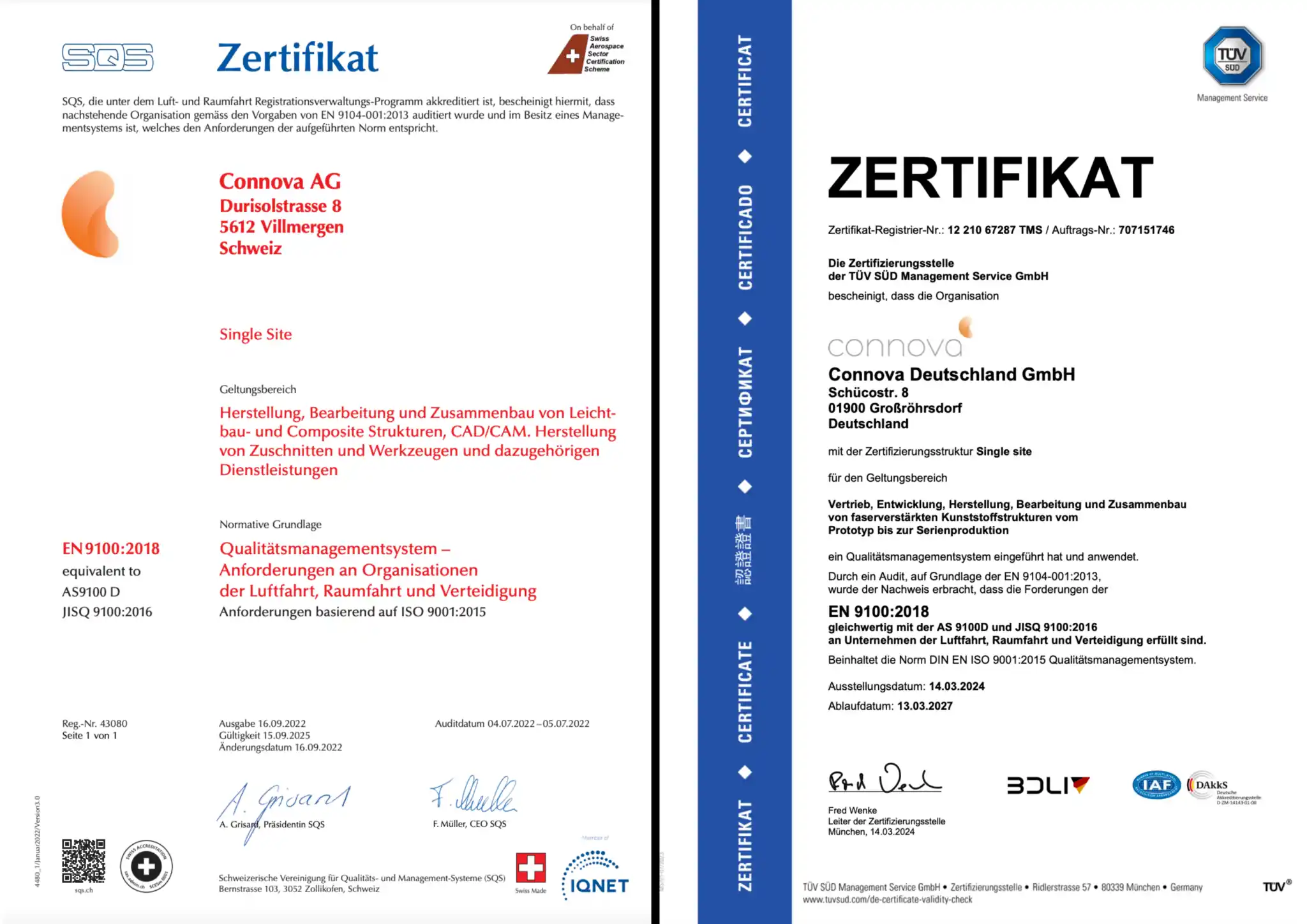
EN 9100 and ISO 9001 – Certified Processes for Automotive Supply

In addition to ISO 9001, we are certified to EN 9100 – the quality management system of the aerospace industry. For automotive and motorsport customers, this means a level of requirements that goes beyond standard industry specifications.

Composite materials in the automotive and racing industries

Through the innovative use of composite materials, we are revolutionizing the automotive and racing industries. Our advanced racing and sports car components offer an unbeatable combination of lightness, strength and durability. They significantly improve the aerodynamic properties and thereby contribute to a significant increase in fuel efficiency and overall performance. Through these technological advances, we are setting new standards in the world of motorsports and performance-oriented automobile manufacturing.

Why Weight in a Vehicle Determines Performance

In a vehicle, mass acts in three places at once: when accelerating, when braking and in every corner. In motorsport, this translates directly into lap time and fuel efficiency; in production vehicles, into consumption and range.

768 kg

Minimum weight of a Formula 1 car from the 2026 season – around 30 kg less than in the previous season.

Source: FIA Technical Regulations 2026

350 °C

Operating temperature withstood by our composite heat shield for the Porsche 918 Spyder.

Source: Connova project data

1 000+

Production cycles per component for which the series tool for the heat shield was designed.

Source: Connova project data

up to 60%

Weight savings compared to the metal version with the same component stiffness.

Guideline value from design projects, depending on the load case

How much weight can be saved in a specific case depends on the load case. For components subject to bending, the advantage is greater than under pure tensile loading. We calculate the reliable value for your component as part of the feasibility analysis – before the quote.

Our success stories

Why Connova Is Chosen for Motorsport and Automotive Projects

Six points that describe our position in Formula 1 and automotive engineering – each with a verifiable reference on this page.

Over 30 Years of Manufacturing for Formula 1, Including for the Sauber Team

Evidence: Section on Motorsport and the Automotive Industry, and the Aerodynamic Structures Success Story

Manufacturing Depth from Toolmaking to Composites, Assembly and Painting, All In-House

Evidence: Toolmaking Section, Core Competencies, Sportec SPR1 Success Story

Series Production Experience in Automotive Engineering, Not Just One-Offs

Evidence: Porsche 918, Series Tool for at Least 1,000 Production Cycles

Certified to EN 9100 and ISO 9001

Evidence: EN 9100 and ISO 9001 section

Strak and Class A Surface Development as a Continuous Chain Through to the Painted Component

Evidence: Section From Strak to Class A Surface

Two Production Sites in Switzerland and Germany

Evidence: Villmergen (CH) and Klipphausen (DE), see footer

Excellence in Motorsports & Automotive

Since its founding, the Connova Group has been developing and building structural components as well as high-temperature and aerodynamic components for Formula 1. As the use of CFRP in this area is becoming increasingly widely accepted in the automotive industry, the Connova Group is increasingly working for leading OEMs and large suppliers to the industry. Every year, the Connova Group invests in even more efficient production facilities in order to continuously keep the processes at the cutting edge of technology.

Composites in Vehicle Construction – Frequently Asked Questions

Which fiber composite materials are used in the automotive industry?

Carbon fiber reinforced plastics (CFRP) and glass fiber reinforced plastics (GFRP) dominate in vehicle construction. CFRP is used where stiffness and weight are critical to function – in structural, aerodynamic and visible exterior components. GFRP is more economical and is used for less highly stressed panels. Aramid fibers supplement the layup where impact resistance is required. Epoxy resin systems dominate as the matrix; thermoplastic systems are gaining importance where short cycle times and recyclability are the priority.

The threshold is not a fixed number but the ratio of tooling costs, cycle time and material usage. Prepreg autoclave processing is suitable for single parts up to medium series because tooling costs remain moderate, although the cycle time is long. Hot pressing and RTM pay off from the point at which the more expensive tool is amortized over the quantity. As a guideline: prepreg autoclave processing is viable from one-off production up to around 5,000 units per year. In the feasibility analysis, we usually calculate two process variants and disclose both cost calculations.

Five factors determine the price: the material system (fiber type and matrix), the material usage resulting from the layup, the tooling costs and how they are distributed over the quantity, the manufacturing process and its cycle time, and finally the scope of rework and inspection. For qualified components, the effort for first article inspection and documentation is added. The greatest lever almost always lies in the design, not in purchasing – a component designed for composites is significantly cheaper than one carried over from metal.

In modern motorsport, these include the monocoque, front and rear wings, underbody and diffuser, body panels, exhaust heat shields, seat shells, as well as attachment and suspension parts. We have been manufacturing structural components as well as high-temperature and aerodynamic components for Formula 1 since our founding years and deliver them ready to install on request.

With a density of around 1.5 to 1.6 g/cm³, CFRP has about one fifth the density of steel and just over half the density of aluminum.However, this does not yet describe the actual weight savings on the component: they depend on the load case.

The extremely high tensile strength combined with low elasticity is what makes CFRP unbeatable. This is the main reason why bending loads in particular can be absorbed so well.

The weight advantage is therefore significantly greater for components subject to bending than under pure tensile loading, because stiffness plays a disproportionately large role in the design. We determine the reliable value for your component during the design process – not by rule of thumb.

On the tool side, we typically achieve a contour accuracy of ±0.2 to ±0.5 mm, depending on component size. CNC-machined mating surfaces and hole patterns are produced to within ±0.05 mm. The individual value matters less than the tolerance chain: tooling, curing, demolding and rework all add up. We define this chain together with you before the tool is designed and measure the first component with our own inspection equipment.

We take over the process chain from the released design surface: strak preparation, ply layup design, tool design, manufacturing and surface finishing. This keeps the tolerance chain in one hand all the way to the painted component. Creating the design surface itself remains with you or your design studio.

Yes. Pattern making, mold and toolmaking, as well as CNC milling and contract manufacturing, are core competencies at our sites. As a result, tools and components are made at the same location, which significantly shortens rework after the first component. We also offer pure contract manufacturing for customers who produce themselves.

In electric vehicles, weight directly affects range and the sizing of the chassis, brakes and battery. In addition to body and structural components, composites are found in the drivetrain itself: CFRP bandages and sleeves secure the magnets of high-speed rotors against centrifugal force and separate rotor and stator in pumps and auxiliary units without eddy current losses.

The Connova Group is certified to ISO 9001 and additionally to EN 9100 – the quality management system of the aerospace industry. For automotive and motorsport customers, this means documented traceability from the material batch to the delivered component, as well as approved special processes for curing, bonding and surface treatment.

Non-binding advice for racing solutions

With decades of experience in lightweight construction for the automotive and racing industries, we have the necessary know-how to make your visions come true. We warmly invite you to a professional consultation where we will explore together ways in which we can support you as your future partner. Of course, this consultation is non-binding and free of charge for you.

Composites in Other Industries

Aviation

In aviation, the material proportion of composite components is traditionally high and amounts to up to 60%.

UAVs / Drones

Unmanned aircraft and drones for a wide variety of applications are shaping the future of mobility.

Aerospace

Very light and ultra-stiff carbon fiber composite structures are the standard for demanding structures in aerospace.

Industry Automation

Composite components are becoming increasingly important in mechanical engineering, automation, and robotics, particularly due to their greater cost-effectiveness over their service life.

Marine Shipbuilding

Fiber composites in shipbuilding combine low weight with high corrosion resistance.

Engineering

Composites follow different design rules than metals. We have these laws in our genes. You have the advantage.

Aktuelle Neuigkeiten